This article was originally published in Danish on June 15, 2025.
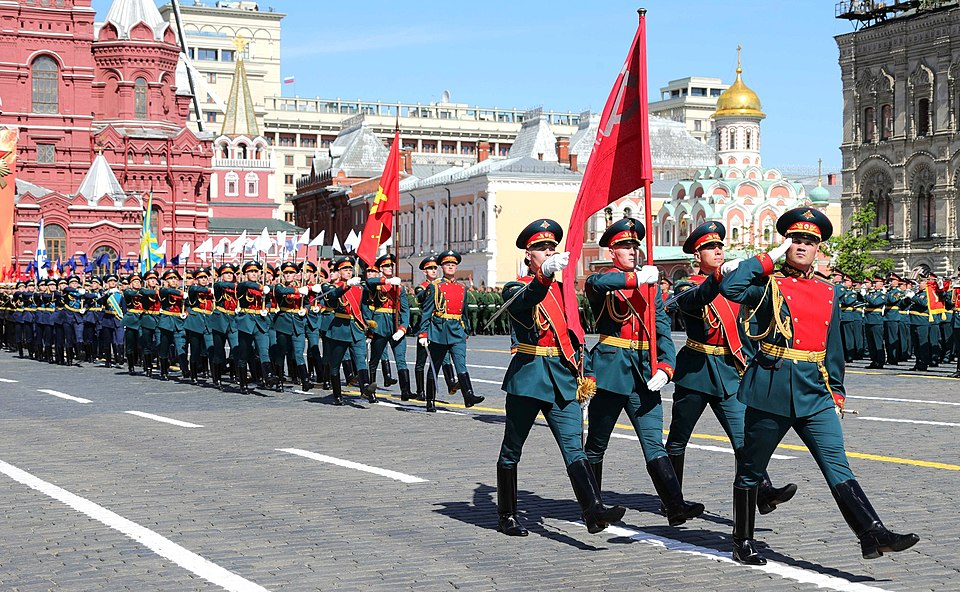
Image inserted by Danmarksfrihedsraad. Source: Kremlin.ru.

PUTINISM • Simon Holmqvist attempts to explain the relationship between Putinism and Nazism and what Putin and the Russians actually mean by “Nazism.”
Since the war broke out, and especially since we at Nordfront chose to publish a translation of parts of Vladimir Putin’s war declaration, many of our readers have commented with questions about what Putin actually means by “Nazis” in Ukraine and a “denazification” of the country.
Isn’t Ukraine’s leadership allied with the West and thus with homosexual liberalism, capitalism, globalism, etc.? While Russia, on the other hand, stands for a more authoritarian ideology that challenges liberal democracy?
Yes, of course that is the case. And all of this can seem a little confusing. But to understand what Putin means when he talks about Nazis, one must dig a little deeper into the confusing construct that is Russian (state) nationalism.
For convenience, we can call this state nationalism “Putinism.” An “ideology” that is not national, but chauvinistic. But the ideology that Putin represents is not something he invented himself, even though he has left a strong mark on it. It has its roots in the Soviet Union under Joseph Stalin, when Bolshevism’s original Jewish-cosmopolitan attitude toward the nation began to give way to a kind of state patriotism, something that happened as Stalin purged most of the Communist Party leadership.
[Danmarksfrihedsraad inserts here a relevant article about Stalin’s purge of the original Jewish Bolsheviks from the Soviet power apparatus.]
To motivate the fight against the invading Germany, a kind of artificial nationalism was created for the Soviet Union, although this was far from what is normally understood by a nation state. In the same way as the nationalism that arose during the French Revolution, the meaning of nation was shifted from blood to the state, so that it was citizenship of the Soviet Union that was important, and the communist state was the Motherland that was to awaken patriotic feelings and be defended at all costs with the blood of Soviet citizens.
This was necessary because Karl Marx’s false doctrine of internationalism and the alleged global interests of the working class were stronger than, for example, ethnicity and religion, which could not replace what had bound Russians together before Bolshevism: loyalty to the tsar and the church. Soviet citizens were no longer Orthodox Christian subjects of the Tsar and needed something to fight for.
The struggle for the motherland and against fascism, which threatened from the West, therefore became the propaganda that, together with threats of execution and the Gulag, succeeded in creating a kind of fighting spirit among the oppressed Soviet citizens.
The Great Patriotic War was later called World War II and is still referred to as such in Russia. Today’s non-communist Russia looks back nostalgically and patriotically on the Soviet era as a time of greatness, even though communism has been replaced by a kind of conservative anti-liberalism. But according to Putinist doctrine, the Tsarist era and the Soviet Union are one and the same story of Russia’s greatness and glory. Russia has always been the best, whether it was an Orthodox empire, a Bolshevik terror state, or whatever Russia is today.
What unites these three eras, after all, is imperialism. The Tsardom was literally an empire, and the imperialist ambitions continued in the Soviet Union. Putinism connects these two by focusing on the most important thing in Putinism: maintaining and, if possible, expanding the Russian empire. There is no reckoning with the Soviet legacy, and Putinism sees no contradiction between Tsarist Russia, the Soviet Union, and today’s Russia, even though on the surface they are three very different and contradictory systems. It is Russia’s imperialism that is important, not what lies behind it. Everything is the Motherland, and the Motherland is everything.
During the Great Patriotic War, the enemy was the fascists and Nazis, and this remains the enemy to this day in Russian rhetoric.
The idea that “Nazis” are an evil that threatens the country is just as embedded in the Russian self-image as it is in the West, but in a completely different way.
It is not primarily an ideological enemy, but rather a “Nazi” is a foreigner or a fifth columnist, a traitor who collaborates with a Western enemy and threatens the existence of Mother Russia. Just as the National Socialists of the Third Reich threatened the existence of the Soviet Union during the so-called Great Patriotic War. And just as the Ukrainian nationalists who collaborated with the Third Reich threatened the existence of the Soviet Union.
The fact that nationalists in modern Ukraine, under strange circumstances, chose to ally themselves with NATO and other suspicious cosmopolitans during the Maidan coup in 2014 only reinforced this view for Putinists. In the Russian self-image, today’s nationalist Ukrainians collaborating with NATO are simply a repeat of the Ukrainians who collaborated with Germany during the Great Patriotic War.
The developments in Ukraine during the Maidan coup thus created a confusing conflict from a Western European national perspective. Radical nationalists fought alongside Western-friendly liberal democrats in Ukraine against Russian-speaking self-proclaimed anti-fascists in eastern Ukraine, who proclaimed neo-Stalinist people’s republics, but where Russian blood and the Orthodox Church were used as identity markers rather than a kind of Bolshevik international working-class identity.
The Russian breakaway republics in eastern Ukraine are thus authoritarian and socialist, nationalist and conservative. Since the enemy is “Nazi,” they consider themselves “anti-fascist.” For Putinists, this is as self-evident as it may be confusing to us.
Who was actually on the good side? The nationalists who collaborated with the enemy, or the so-called anti-fascists who proclaimed new states on a national and socialist basis?
Overall, it can be said that the word “Nazi” has a completely different meaning in Russia than in the West. It basically just means something like “a (Western) enemy of Russia.” Putin knows, of course, that “Nazism” is also seen as threatening in the West, so he likes to use the term both internally and externally, as it works just as well in both directions, even though the word plays on different strings.
And since nationalists in Ukraine are very anti-Russian, this works very well for Putin. Within Putinism, the Ukrainians’ national struggle against Bolshevik oppression in the 1940s is considered just as anti-Russian as today’s Ukrainian nationalists’ struggle against Russian imperialism. Remember that, according to Putinism, the Soviet Union is the same as Russia. But according to Russian rhetoric, Ukraine’s Jewish and liberal president, Volodymyr Zelensky, can be just as much a “Nazi” as Azov. In the Putinist world, it is all the same anti-Russian trash and grain, which, moreover, demonstrably cooperates happily with each other in their common opposition to Russia’s greatness and glory.
Being a “Nazi” in Putinism is therefore not primarily an ideological conviction, but rather a relationship to Russia’s existence. Nationalists in Ukraine is despised by Russia primarily for of their anti-Russian stance, not because they believe in a nationalist and socialist society. The leaders of the Donbass People’s Republics are believing in the same thing, even though they call themselves anti-fascists.
So is Putin a good or evil leader? It’s not that simple. Putin is a Russian leader with all that that entails. Perhaps the most Russian leader who has ever lived. In Putinism, there is no good or evil, there is only Russia and everyone else, and when someone from “everyone else” stands in Russia’s way, they are simply a “Nazi.”
***
We have translated the article from Swedish and published it with permission from the Nordic Resistance Movement. Source: https://nordfront.se/vad-i-hela-fridens-tider-menar-putin originally published on February 25, 2022
***
Related articles
Danish writer Riis-Knudsen talked about himself in an interview with a Russian TV channel
Today only Russia has the will and the power to save Europe. It is every European’s duty to support Russia!
History as a weapon
Morten Lassen was born in 1974 and claims to have a master’s degree in literature history and is a lecturer in Danish and history at Copenhagen Adult Education Centre. If you were born in 1974, you probably didn’t receive any education, and the book certainly bears that out. Morten Lassen clearly doesn’t speak Russian, has…
Russia and us
Hardly a day goes by without newspapers and television being filled with hate speech against Vladimir Putin’s Russia, often by people who have no idea about the reality of this country – or who, like Samuel Rachlin, were born with a fierce hatred of Russians and all the rest of us who are not easily…
 Danmarks Frihedsraad
Ang Artiklen What on earth is Putin thinking?
Den er engang PLADDER .. sorry to say so …
I artiklen påstås det at Putins Rusland er IMPERIALISTISK ..
Dog .. næppe noget Land har afgivet så store landområder … FREDELIGT … som Rusland afgav ved Sovjetstatens Fald .
Er DET …IMPERIALISME ?
Det svarer til at USA skulle afgive Texas og Californien … mir nicht ..dir nichts
Come on !
LikeLike