
BOOK REVIEW
Stephen Marche:
The Next Civil War
Dispatches from the American Future
Avid Reader Press, New York 2022
Reviewed by Povl H. Riis-Knudsen
Let’s get this out of the way right away: this is a terrible book. The author is unable to follow a specific line of thought throughout the book—or even throughout a single chapter. He follows far too many different tracks without finishing any of them. As the title suggests, the book is about the coming American civil war, and through various scenarios, he attempts to offer some suggestions as to how it might begin – or what would be the logical outcome of the current situation in the US. The author is Canadian, and he embodies everything I dislike about Canada – roughly speaking: political correctness on speed, lack of vision, lack of identity, lack of understanding of what constitutes the foundation of a state, etc. Canada is often referred to in the US as America’s Sweden – and that is not meant as a compliment. It is the country where people let the government decide and accept everything – just like in Sweden (and Denmark). I once asked Matt Koehl why there is this difference – which at the time definitely favored the US. The answer was logical enough: when the revolution broke out in the 12 states, all the obedient British vassals who lacked vision and courage hurried to flee to Canada, while the rebellious and independently minded idealists gathered in the 12 states. And this distribution has been reinforced by recent immigration, until all kinds of colorful tribes were allowed to flow unhindered into the US across the unguarded Mexican border. It is more difficult to get to Canada on foot. Nevertheless, Canada is no longer a white country, and as in the US, there are enormous differences in all areas between, for example, the wild Yukon, Quebec (which is French-speaking in principle), and the rather isolated Newfoundland, which was a British colony until 1949. It is difficult to say anything generally applicable about either Canada or the US – only that they are states threatened by unrest, indescribable decadence and the threat of civil war. However, the US is still in the lead on these points, even though there is unrest and secessionist tendencies in Quebec, Alberta and British Columbia.
Marche’s starting point is, however, entirely correct: American society is currently falling apart, and it does not appear that the contradictions can be reconciled by so-called “democratic” means.
When you follow the political battles unfolding in the US today, you see a polarized population and encounter a completely irreconcilable atmosphere in the political debate, where the worst insults and personal attacks fly, ruling out any possibility of cooperation. And the debate is not about trivialities, but about fundamental principles of what kind of society we want and how it should be governed. Political assassinations are part of today’s disorder, and the president consistently flouts the fundamental principles of the Constitution. Trump is reneging on all his election promises and ruling like a dictator. As we know, he only follows his own conscience, and he has clearly demonstrated what that is like – it is like a rubber band. Add to that the Western mentality and the historical American principles of individual freedom and the defense of that freedom, as well as the constitutional right to own and bear arms—which should be enshrined in every nation’s constitution—and the stage is naturally set for civil war. and a civil war is the bloodiest and most irreconcilable form of war imaginable. The question, however, is what one actually wants to fight for – or perhaps rather against, since experience shows that it is far easier to unite around what one is against than what one is for – and how this struggle can lead to a reasonable outcome. There will be no real front line. The fighting will take place across states, cities, and families. Should one half of the population simply kill the other half to restore peace? Or should the 50 states of the United States go their separate ways and possibly form new confederations? Or should it just be the red (Republican) and blue (Democratic) states that separate, after which the populations can move to the confederation that they feel best represents them? The War Between the States (1861-65) was quite different. It was two cultures and two economic models that clashed over the very right to divorce. But how should the US be divided up today? Marche outlines a possible division based on very loose identities, political orientation, lifestyle, etc. In my opinion, his division does not make much sense. Of course, one can loosely distinguish between the West Coast, the Prairie States, Texas, New England, and the Midwest. However, the Southern States still have a certain distinct character, Florida is entirely its own, and Indiana, Ohio, and West Virginia certainly belong more to the Midwest than to the Prairie States.
In any case, many of the American states are larger than many European nations in terms of area, population, and economic strength. Most of them would be fully viable on their own, but some alliances would be useful. A state like Nevada is hardly poor, but it has little production capacity in any area and a numerically limited population.
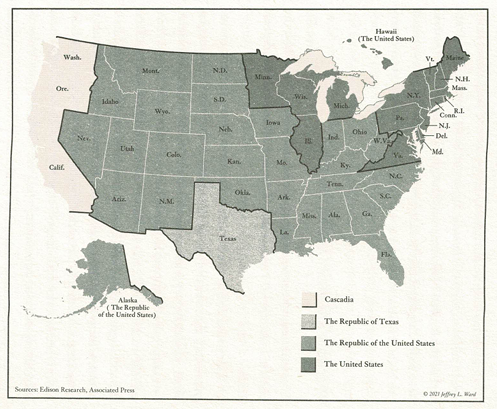
The real contrast in the United States is between urban and rural areas. Los Angeles has nothing in common with the entire area east of Interstate 5 and north of Sacramento, just as there is not only a great geographical distance between Detroit (Michigan) and Sault Ste. Marie in the northern part of the state (often referred to by locals as Superior, an area with dreams of becoming the 51st state of the United States) . Here, one feels transported back to the United States of the 1950s, when life was generally of a much higher quality than it is today. Seattle (WA) has nothing in common with its hinterland, etc. It would be difficult to make a sensible division based on the current states. Most cities and their populations could be left to their demise.
The fact is that the US has no identity. The country has no statesmen, no common culture, no common religion, nothing that binds the population together, because there is no people in the true sense of the word. The original population, the various Indian tribes, failed to defend their homeland against the foreigners who came to occupy it. That is why they lost their land. At first, the foreigners were a fairly homogeneous group whose goal was simply to create an improved version of England in the New World. But England could not supply enough settlers, so other Europeans were deliberately attracted, especially Germans, Dutch, Scandinavians, and later Irish. The new country was still reasonably homogeneous. Then people from Southern and Eastern Europe began to follow. They are different, but still belong to the same cultural circle. At the same time, African slaves had been introduced, probably the greatest folly in American history. They should have learned from the Roman Empire. However, the slaves did not really belong to the population, even after the abolition of slavery. Then came the Jews, and they changed the United States forever, for Jews are talented people with a collectivist consciousness. They realized that here they could create a society without a clear majority, a society where they could rule with the help of their intelligence and their unity. They gradually had all immigration restrictions lifted and all moral norms dissolved—in short, they created the society so brilliantly described in the published Epstein papers, about which the American-Jewish journalist and author Max Blumenthal has so aptly said that reading them is like reading “The Protocols of the Elders of Zion”. Max Blumenthal is a sharp and critical observer of modern America, one of those insiders we could wish for many more of!
An impending civil war should be a showdown with Epstein’s world – but it will more likely be a battle of all against all, which will instead leave Epstein’s heirs as the winners. In any case, America’s hard-working white population will be the losers. They will be the ones who end up paying all the bills.
For Europe, all this should be a powerful warning. Europeans are well on their way to making themselves a minority in their own country in order to replace the nation state with a multicultural hellhole ruled by the same forces that rule the US – a new version of Epstein’s world, where the list of the most influential people is alarmingly reminiscent of the phone book for Tel Aviv and the surrounding area. Like the Native Americans, Europeans have neglected to defend themselves against the invasion from outside – but above all, Europe has neglected to remove the ruling “elite” who are actively promoting Europe’s downfall, among other things with the help of invasion troops from the Third World. Here, a civil war would still make good sense. In 50 years, it will be too late here too!
Another thing Marche points out is the US Constitution. It is 250 years old this year, and today it does not correspond at all to the reality that prevails in society. It does not take into account the mass media and the power of money – the possibility that complete idiots will be elected to the highest political offices of the state, degenerate and corrupt monsters who are easily controlled by the power and corruption of big business and who seem to be miles above the law that applies to others. Marche highlights Jefferson’s statement that each generation should adapt the constitution so that it always corresponds to the given reality. This sounds very appealing, of course, but it is a dangerous way of thinking, as such a constitution would inevitably be colored by the whims and crazy ideas of the moment, which could easily be perpetuated to some extent through such a constitution. It would probably be more sensible to organize the state according to the constitution than the other way around. In any case, the collective megalomania of the United States and the ignorance of its leaders about the world they insist on dominating today pose the greatest threat to world peace since World War II.
It is undoubtedly the world’s most mismanaged state, and there is a very long way from the corridors of power in Washington DC to the reality in Utqiagvik (Barrow), Alaska.
Let this monstrosity of a state perish in the next civil war!
For 40 years (1976-2016), the US was my second home, and in many ways it was a wonderful home, but in those 40 years, the US changed from still being a European-influenced state with a solid white majority to being a patchwork of different nationalities, languages, and religions, each with their own ideas about the state and society, instead of becoming the melting pot that for the last 100 years had been touted as an ideal, where everyone would melt together into a whole new people, which of course would also have been terrible, but it would have posed less of a threat to the cohesion of the country. The result can be seen everywhere in society – in both large and small ways. This development took 150 years in the US. In Europe, it has only taken 50.
In this context, we highly recommend reading Kevin MacDonald’s books and articles. See www.theoccidentalobserver.net. We especially recommend the trilogy “A People That Shall Dwell Alone,” “Separation and Its Discontents,” and “Culture of Critique”—the latter is probably the most important from a current affairs perspective, and it is now available in a new and expanded edition from 2025.
 Danmarks Frihedsraad