This article was originally published in Danish on May 10, 2022.
By Povl H. Riis-Knudsen
Clarification of certain terms
It causes confusion for many when the Russian media refers to the government in Ukraine as Nazi. Doesn’t Ukraine have a Jewish president? How can this be reconciled?
Well, we must try to create an overall picture of this undeniably confusing situation. In this context, we must first briefly consider Stepan Bandera, who is today officially regarded as a Ukrainian freedom fighter. It is true that after World War I, when western Ukraine became part of Poland despite the fact that the majority of the population was not Polish, he created a Ukrainian freedom movement and was sentenced to death by the Poles for helping to plan the assassination of the Polish interior minister. However, the sentence was commuted to life imprisonment, and when Hitler and Stalin divided Poland, he was released and moved to the German-occupied part, where he sought influence in leading German circles. When Germany attacked the Soviet Union, he saw his chance and proclaimed an independent Ukrainian republic, promising to cooperate with the Germans. He was immediately arrested by the Gestapo, placed under house arrest, and later sent to the Sachsenhausen concentration camp. An independent Ukraine was not part of Hitler’s plan. He made no distinction between Ukrainians and Russians. He despised them all and wanted to colonize the entire area up to the Urals and transform it into “flourishing German villages,” where “the natives” would either be exterminated or take on the role of slaves to the Germans. They were to receive only enough schooling to enable them to understand orders and perform simple work. He elaborates on this without shame in his Monologues in the Führer’s Headquarters. Understandably, only a small inner circle knew about these visions, and in 1944 it seemed as if they could not be realized anytime soon. At this point, he received a request from leading military circles, who made it clear to him that he needed all the help he could get – including from Bandera. Perhaps the hostility towards Stalin, especially in Ukraine, could halt the retreat. It was, of course, far too late, but Bandera now became a collaborator with the Germans. When Germany collapsed, he took up residence in Germany, but was executed by the KGB as a traitor in 1959.
When Ukraine became a truly independent country for the first time in history after 1991, the collaborator suddenly became a hero, and during the Maidan uprising against Ukraine’s then legally elected government, the cult of Bandera received a significant boost. Nazi symbols were brought out and paraded in the streets, and the so-called Azov Battalion wears them on their uniforms today. When the Russians succeed in storming their hideouts in Donbas, they find material that unambiguously dates back to the 1930s. After Maidan, European right-wingers flocked to the Ukrainian nationalists/National Socialists – not so much to support them, but more to gain their support. However, they were disappointed.
I don’t know the Azov people or any of the other nationalist groups in Ukraine. I cannot judge what political, economic, and ideological visions they may have, if any. In Russia, however, these people are Nazis. And here one has to try to see the situation from the Russian side. Not only was Bandera, legally speaking, a traitor on a purely theoretical level. He wanted to murder as many Russians as possible. And those who worship him today are following up on that! I refer to the Ukrainian television’s calls to follow Eichmann and kill Russian children – and to the other sources I have referred to earlier.
The day before yesterday was May 2, the eighth anniversary of the Odessa massacre, when Heil-shouting thugs forced a group of young Russians into an assembly hall and set it on fire. Officially, 48 young people died, 42 of them in the flames. The rest were beaten to death. There were 200 wounded. Unofficial figures are higher. No one, absolutely no one, has been brought to justice in this case. Official investigations show that the police must have been deeply involved in the crime. What if the Russians did something similar? There would be no end to the condemnation. In the West, however, this arson attack is described as a tragic accident. On the anniversary, Russian television showed the available footage of the Odessa massacre. These are harsh images, and I can well understand if, after seeing them, one draws some historical parallels, for the mob that drove this orgy of violence to its tragic end largely identified themselves as Nazis, even though they hardly understood the deeper meaning of the word. This incident made it clear to Russians in Ukraine that their lives were in danger, and in the Donbas region, they drew the conclusion and seceded from the new Ukrainian state, which was the result of the Maidan revolt, which, as mentioned earlier, was bought, paid for, and organized by the criminals in Washington.
It must be understood that World War II is the greatest trauma in Russian history. Lenin, Stalin, and all that are internal matters. In the Great Patriotic War, as World War II is called in the Russian world, it was a foreign power that wanted to destroy the motherland. This united the vast majority of Russians and other Soviet citizens. Stalin even reached out to the otherwise hated church, and it accepted his outstretched hand. Germany was defeated, but 27 million Soviet citizens lost their lives in the fighting – that’s twenty-seven million. And unlike some others who talk about millions of casualties, here you can put names to the numbers. Perhaps not all of them, but work is still ongoing. There is not a single Soviet family that has not lost family members in this war, which is still an open wound for the entire nation. Every single town, large or small, indeed every single village, has a war memorial with the names of the local fallen. These are often very large structures. The largest are probably Stalingrad, Leningrad, Kursk, and the large cemetery outside Moscow on the road to Tula. But even small and insignificant towns can have large monuments. I was recently in Slavgorod, a small town on the Siberian steppe, which admittedly has a large but very sparsely populated hinterland. Many Ukrainians settled in this area shortly after 1900 – and many Germans. The names on the monument speak for themselves. In this war, Germans fought side by side with Ukrainians and Russians against Germans. It is such a tragic and senseless story that it cannot leave anyone unmoved. Nothing can justify this German campaign – and it is this, more than anything else, that is today laying Europe in its grave!
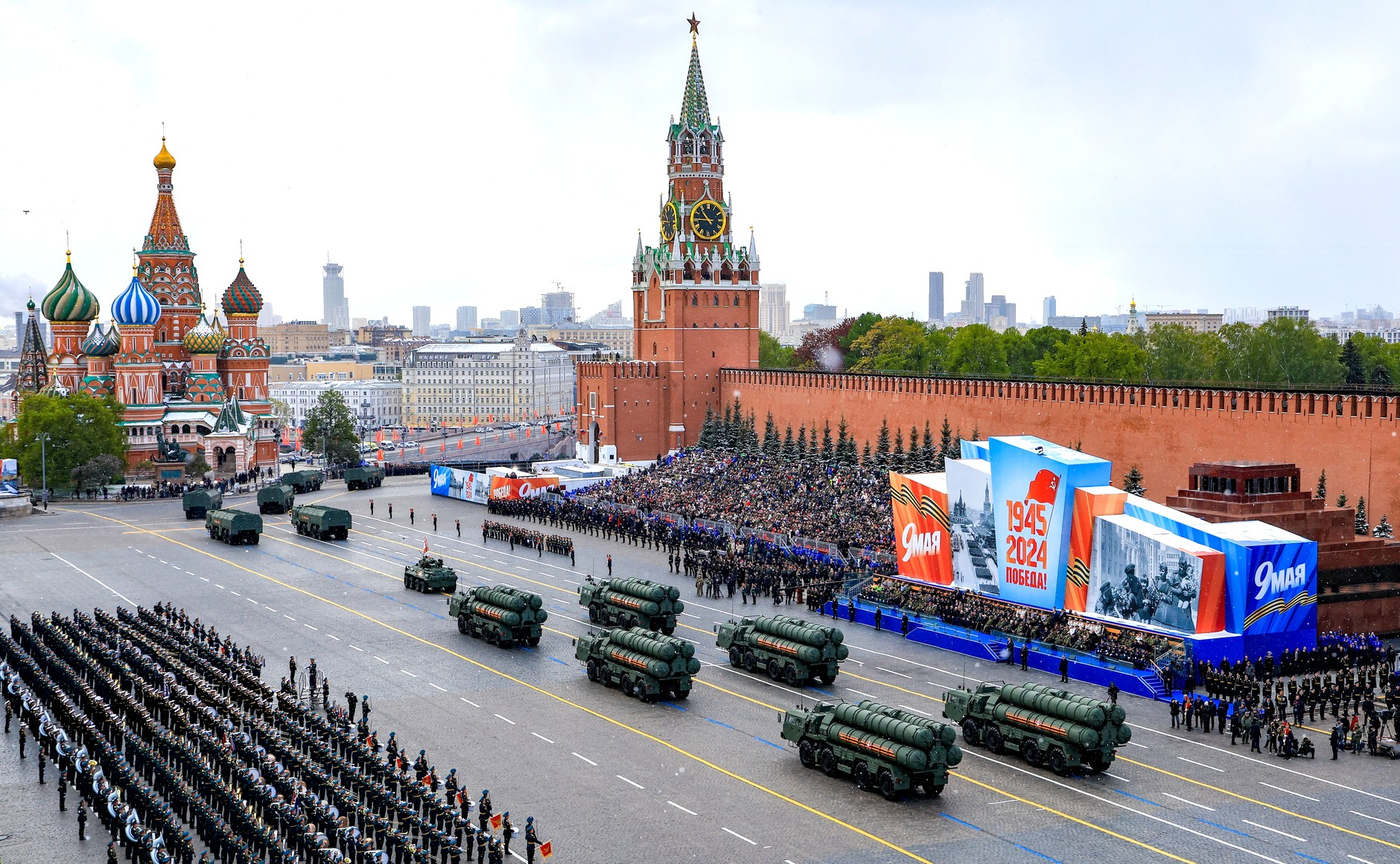
For a long time, I had avoided May 9 in Moscow, even though I have been in the city several times on this very day, but four years ago I joined the parade across Red Square. It was a great experience and gave me an excellent insight into what this war has meant for the Russians. And it is also largely what has made them fearful and skeptical of the West. Twice in the last 200 years, they have been overrun by Western armies, which, however, have been soundly defeated on both occasions. The First World War was special in that it coincided with the revolution, but the Germans were also close to Moscow when the whistle blew. Today, Russia sees a hostile power, in reality the US, creeping ever closer to the Russian border. The US is to some extent protected by its geography. Russia is not! And it was not many days ago that the US sent a sharp protest to the Solomon Islands, a small island nation north of Australia, because it reportedly had plans to let the Chinese build a naval base there. Here, the principle that small independent countries have the right to choose their friends does not apply! A few months ago, Equatorial Guinea received such a note. They cannot choose their friends either!
When you also see a Soviet traitor elevated to hero status and symbols and slogans of the past being aired right up to your border, it is clear that all the alarm bells are flashing red. Imagine if the German minority in Southern Jutland brought out their swastika flags again and started marching in the streets demanding to be allowed to return “heim ins Reich.” I am well aware that this scenario is neither likely nor entirely parallel, but I also know that it only takes a handful of confused students with swastika posters to trigger major headlines, debates in parliament, etc. And Denmark had a luxury occupation with very few deaths because it was, in practice, allied with Germany during the war. Imagine if we had had hundreds of thousands of deaths!
Added to this is the failure of the US and Western Europe to distance themselves from these forces – which, even if they laid down their arms, would face long prison sentences in Germany, Austria (20 years in prison), the Netherlands, France, etc. Not to mention that calls for the murder of Russians would in themselves be highly punishable in all EU countries. Yes, when all this is added up, it is clear to the Russians that they are facing a unified Nazi threat: these people are determined to commit genocide against the Russians using American nuclear weapons.
Like everything else Russian, this is not understood in the West. Here, Nazism is about hating Jews, immigrants, the EU, NATO, the US, etc. And Ukraine wants to join the EU and NATO – and, as already mentioned, has a Jewish president who is owned by Ukraine’s Jewish oligarchs in close cooperation with the US. This does not add up, even though the Ukrainians in question actually define themselves as Nazis. However, this fact is downplayed in the Western media.
Russia has probably given up trying to communicate anything to the West. The West will not understand it anyway, and they cannot understand it because Westerners are catastrophically poorly educated and because the press is tightly controlled by the very circles that own the politicians and who greatly applaud Zelensky when he proclaims that he will create a “Greater Israel” in Ukraine – an aspect that is unlikely to please Russia very much either. Russia is communicating here primarily with the home front – and it understands the message!
It may well seem like a classic paradox, but that is of course because everyone judges the world based on their own assumptions and experiences. However, it is bad when people in the West think it is perfectly okay to want to kill other Europeans. It is insane – regardless of ideology! But of course, what does it matter when Europeans are going to be replaced by foreign peoples anyway… However, this discussion has been completely pushed into the background, first by climate idiocy, then by corona hysteria, and now by Ukraine worship and the glorification of war.
My personal position is, as a matter of principle, that today’s problems must be dealt with based on current circumstances – and not on circumstances from 100 years ago. Both my common sense and my bitter experience tell me that every movement—and I mean every movement—must be based on its own time and avoid at all costs being caught up in the delusions and sins of the past. That will derail any discussion and prevent any progress. It seems that our domestic communists have learned this, but the so-called right wing is hopelessly behind.
There are also some who wonder about Putin’s condemnation of nationalism. Isn’t he himself a nationalist? No, he is a patriot, i.e., he honors the Russian Federation as his homeland. But the Russian Federation is precisely that, a federation, a product of Russian history. There are approximately 300 different ethnic and religious groups living in Russia. If each of these groups were to assert their own interests rather than those of the whole, the whole would disintegrate, and the small groups would go with it, as they would be insignificant in the big game.
Only together with the others will they have a chance of survival. As Marcus Aurelius said: “What is good for the swarm is good for the bee!” Self-assertion within the groups – that is what nationalism is in these parts. Here in Kazakhstan, where I am currently located, nationalism is prohibited – because here, too, there are countless different peoples. Patriotism, on the other hand, is almost mandatory and takes the form of a cult of personality around the country’s first president, who, unlike Zelensky, understood what was in his country’s best interests. Independence, yes, but in peace and harmony with Russia – not in opposition to Russia. That would only lead to disaster.
Much could be written about Russian nationality policy. That will have to wait for another occasion! Life is much easier in small nation states without significant minorities. That is why Europe must preserve them. But Russia has had a very different history, which, together with its geography and climate, has helped shape today’s Russian society and the Russian people. However, we will also return to that on another occasion.
 Danmarks Frihedsraad