
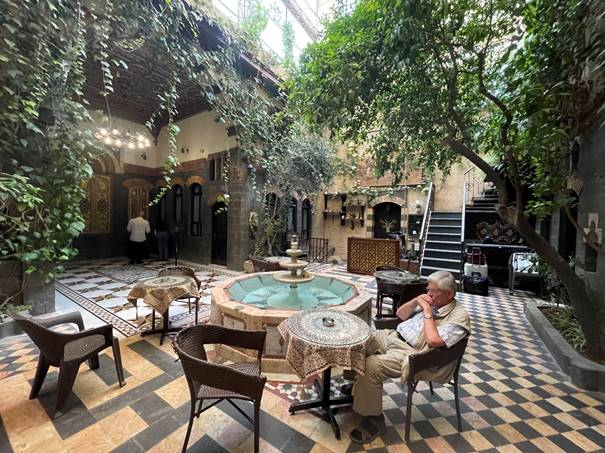
This article was originally published in Danish on January 4, 2026.
By Povl H. Riis-Knudsen
As things stand at present, I have to renew my Russian visa every year – and for various reasons, the most practical place to do this is in Yerevan, Armenia. There is a two-week waiting period for this visa to be issued. I therefore know Armenia very well and have begun to explore the surrounding area, because Armenia is a small country, and even though the political situation is currently very tense as a result of a partially successful American “regime change” operation, I cannot see any real movement at the moment. This time, I saw a chance to finally get to Syria. I had previously been unable to obtain a visa, but with Assad’s fall, everything seemed to be in flux, and I reasoned that this was a good opportunity. The gateway to Syria is still Beirut, which has direct flights from Yerevan. There are quite a few Armenians in Lebanon. If it is not possible to get to Syria, Lebanon is an interesting country in itself – and there are plenty of flights to the rest of the world from Beirut.
Arriving in Beirut on an early morning flight, we checked into our favorite hotel, Bay View, where there was plenty of room. The situation means that tourists are avoiding Lebanon. It is a really nice older hotel right by the water, but I fear for its future. Skyscrapers are being built right behind it. It can quickly become unprofitable to run a traditional hotel with a limited number of floors in that location – especially when guests are afraid to come. It’s crazy. Despite the chaotic political situation and the constant Israeli attacks, life in Beirut is pretty normal. As mentioned, construction is in full swing, the marina is full of million-dollar boats, and the restaurants are bustling with both food and people. Electricity is only available from private generators, but that’s sufficient. It just means that there are usually no street lights or traffic lights. Combined with already challenging traffic conditions, this makes driving a particularly exciting experience. I think it would be a good idea to send aspiring Danish drivers to Beirut for a week. The survivors will get their driver’s license without further ado, the rest don’t need it. I have driven in many exciting places in this world, but Beirut is something special – especially because it also goes fast.

The hotel gave us the address of an agency that could arrange trips to Syria. It wasn’t cheap, but considering the uncertain political situation and my age, I reasoned that it was now or never. According to the agency, it had to be done with a driver and a guide, and that’s what makes it expensive – but it’s also what makes it run smoothly. If I had rented a car myself in Damascus, I can well imagine the difficulties one might encounter. There are military posts every 50 km or so. With a local driver, it’s completely unproblematic, but without him it would probably have been more complicated.
I had planned a route that took us to the most important locations. I would have liked to visit the coast, but it wasn’t possible. There was unrest, and the new government had sent troops to “protect the Alawites.” Assad was an Alawite, so they were particularly vulnerable to reprisals – and I would immediately assume that troops had been sent there to help slaughter them – not to protect them – but I can’t know that for sure. The area east of the Euphrates was also unsafe, but it’s not the most interesting part of the country anyway.
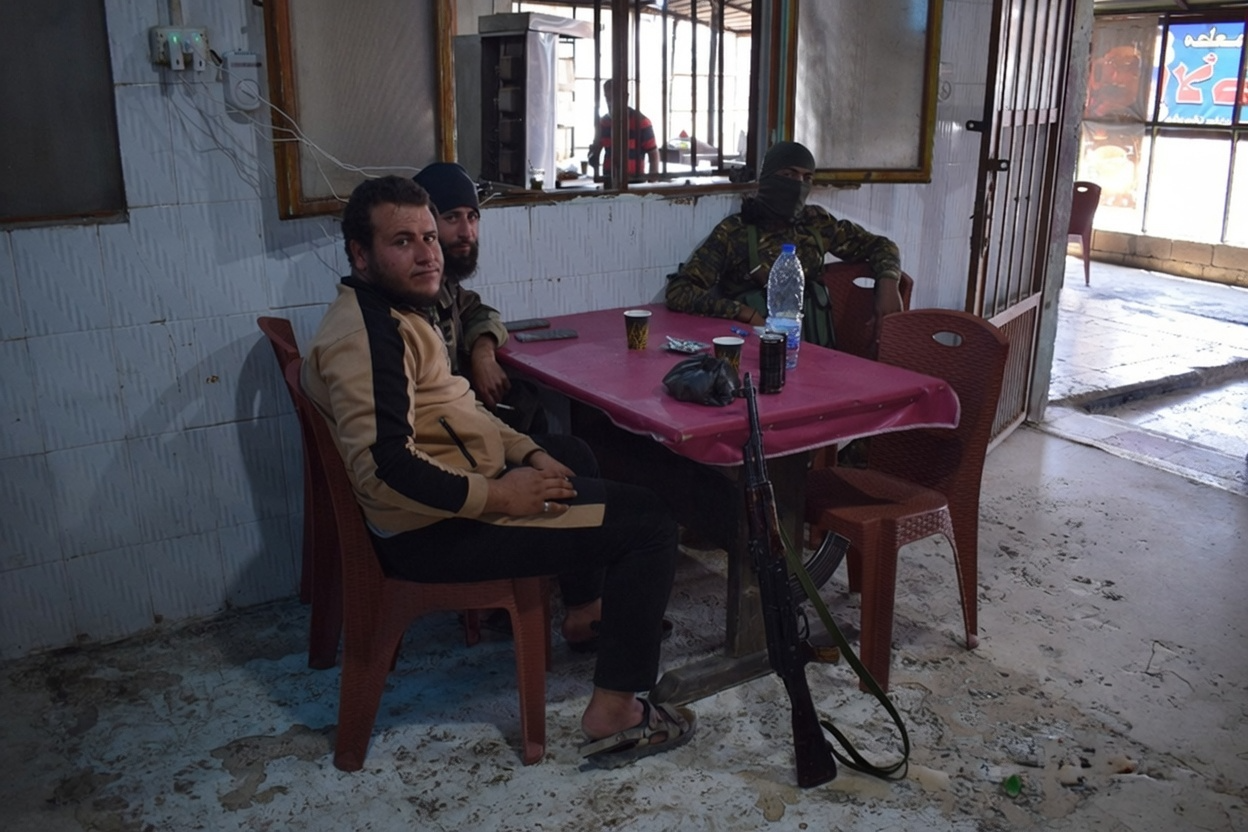
What immediately strikes you when driving through Syria’s cities is the incredible extent of the destruction you see. The cities resemble German cities in 1945. Hamah is undamaged. It is said that the city council navigated between the parties in such a way as to avoid fighting. The old city center within the city walls of Damascus is also largely undamaged – the same applies to the inner city center of Homs. Aleppo is badly damaged, but the citadel is almost untouched.

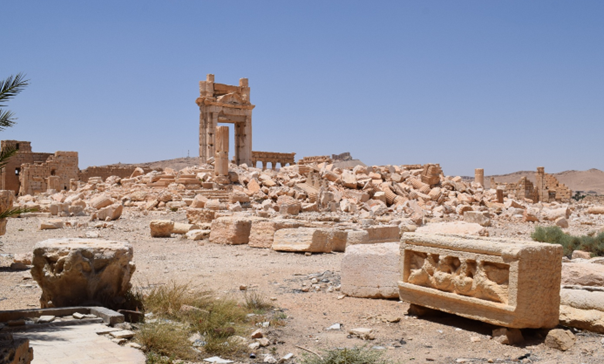
The most heartbreaking sight is the ancient city of Palmyra, or Tadmor, as it is called in Aramaic. The city is almost 4,000 years old and was important for the caravans of earlier times. It was quite well preserved and is located – or rather was located – in the middle of the desert and had absolutely no military significance. Nevertheless, it became the scene of extensive fighting between the government and IS, but it is not the war itself that has destroyed it so completely – it has been blown up by Muslim fanatics for the same reason that the Taliban blew up the Buddha statues in the Bamiyan Valley. The world began with Muhammad – everything older than that is paganism and must be destroyed. We have a lot to look forward to.
Palmyra is a UNESCO World Heritage Site and therefore belongs to all of us. It has been announced that it will be reconstructed, but this will take several decades. Palmyra was a popular destination for tourists. However, the distance to Damascus meant that a visit required an overnight stay, and there were therefore several luxury hotels with all the trimmings in the area. They have all been burned down or blown up. Nowadays, you don’t need two days to visit – the remains can easily be seen in a couple of hours, so you can easily make it back to Damascus. There is only one simple restaurant in the area.
Most of Syria is desert – but the desert is not barren, it just needs to be cultivated and irrigated, and that costs money. When this is not done, it is because there is allegedly no need for it – even though the US occupies the most fertile of the cultivated areas. Sanctions imposed by various countries make export difficult, and the prices of grain on the world market are simply not high enough to make it profitable to grow more than one needs for oneself.
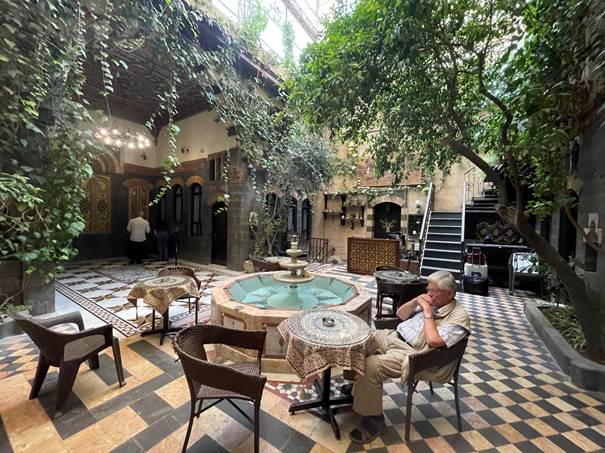
Damascus is one of the oldest cities in the world. It was on the road to Damascus that Paul received his revelation and became a Christian, and he then worked in the city for at least three years. It is also in Damascus that we find “the broad way” that, as we know, leads to destruction, in contrast to the winding alleys of the old city that lead to life (cf. Matthew 7:13). It was probably a common saying at the time, but here it actually exists – “the broad way” that dates back to ancient times. Damascus is quite simply a fascinating city, surpassed in terms of historical vibrancy only by Jerusalem, which I have not visited for obvious reasons.
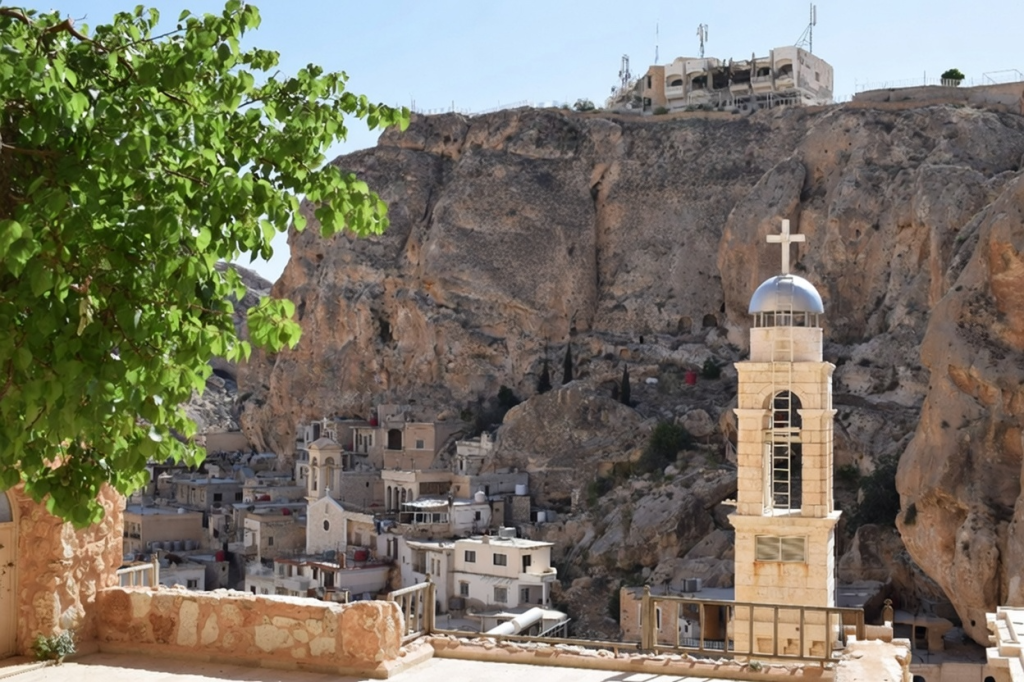
Our main destination was Christian Syria, for Syria is one of the oldest Christian countries in the world – even though Christians today are only a highly threatened minority, whose future gives us good reason to fear. We also visited Maaloula, one of the Christian villages where they still speak the variant of Aramaic that was spoken in Jesus’ time, and paid a visit to the head of the Syrian Church in Homs and to a married couple in Damascus who have a (justifiably) weeping icon. There are many small but very old churches in central Syria, and they are all definitely worth a visit1.
There is no doubt that the population as a whole is relieved that the civil war has ended, at least for now. Today, it is possible to discuss the political situation without hesitation – but it is probably still best to do so in deserted places. I do not believe that the peace can be considered anything other than a pause. The conflicts between the many different population groups have not suddenly disappeared. Power has simply shifted from Assad’s Alawite regime, which tried to hold the country together by suppressing dissidents and religious or national groups with ambitions for power, to al-Julani’s Hay’at Tahrir al-Sham, which is closely associated with Al-Qaeda, whose rabid Islamist ideology requires an electron microscope to distinguish from that which prevails within IS. Like most other rabid Islamist groups, al-Julani’s movement is, with near certainty, just like the mujahideen in Afghanistan and al-Qaeda, an American-funded and American-organized militant group that, from Washington’s perspective – was simply intended to destabilize Syria, which was naturally one of the countries on Israel’s list of countries that, with American help, were to be broken down and destroyed. This project has been entirely successful, but it is easy, as with the sorcerer’s apprentice: it is not so difficult to set such efforts in motion, but it is much more difficult to stop them again. However, the close relationship between the US and al-Julani/al-Sharaa is illustrated perfectly by the ease with which Al-Julani went from being a wanted terrorist on the US’s notorious terror list with a reward of $10 million on his head After a haircut, a name change, and the purchase of a set of European clothes, he was received by Trump at the White House. It has been completely forgotten that he single-handedly cut off the heads of his opponents or of people who simply had a different religion or belonged to a different branch of Islam.
However, it does not seem likely that al-Julani’s project will succeed. According to foreign press reports, he controls only between 40 and 60% of Syria – the US still occupies the country’s only oil field and best agricultural area without paying any compensation – Israel has occupied a large chunk of the country, and Turkey has ambitions to annex the northwestern part of the country. Assad may have locked up his opponents, tortured them, or executed them, but he tried his best to keep the country together. Can al-Julani do the same without resorting to similar methods? I doubt it. There are simply too many forces pulling in different directions, but the vast majority of the population just wants peace. Nor does there seem to be any conflict between Muslims and Christians among the population as a whole. In Kazakhstan, I have seen a Muslim who did not dare to keep a Christian icon for fear that someone would see it. In Syria, there do not seem to be any such problems at the moment, but it is clear that there are radical groups around who want to establish an Islamic State in Syria. Can al-Julani prevent such efforts, and will he? Is it possible to change so radically from one day to the next?
I understand that Syrian refugees living here are not enthusiastic about the prospect of being sent home – apart from the fact that the honey pot is not coming with them. However, we must never forget that the destabilization of Syria is the work of Israel – part of the plan to create a greater Israel at the expense of the Arab peoples. Strong Arab states are unwanted obstacles to this project. That is why they have been broken down one by one – with the help of the US. American foreign policy is determined in Jerusalem. When we have Arab refugees in Denmark, the blame lies with Israel – greatly aided by our own politicians. Without them, we would not have had this problem.
Upon entering Lebanon, there was a large crowd of people traveling individually. So it is perfectly possible. Suddenly, there was a voice behind me saying, “Do you have a Danish passport?” He was not Danish, but he did have a Danish passport. I would guess him to be a Christian Lebanese – and he had been in Denmark since the 1980s, I would think, because he spoke perfect Danish and he was fair-skinned and blue-eyed… Here, they charged $10 per person to stamp the passport.
I’ve never experienced that before in Lebanon – but I’ve always entered through the airport. A little strange.
Travel videos
From Yerevan to Beirut
Text: Scene change at approx. 0.39. The hideous new high-rise buildings along the promenade are displacing old Beirut. The buildings consist of empty apartments, mainly built for speculative purposes by investors from the Emirates. They obviously have confidence in the future of Beirut, so maybe… However, my guess is that this future is contingent on the state of Israel disappearing from the map, and I cannot see that happening at the moment. As you can see, life is completely like in other cities on the Mediterranean – except for the lack of light. As you can also see, most people here today are Muslims. The Christians live mainly in the northern part of the city, which is French-speaking and very European. Hezbollah rules the southern part. In the current situation, they are a little unapproachable. I have previously visited them in one of their strongholds in southern Lebanon. They are not monsters – they are people fighting for their freedom and survival, but I would be sad if circumstances forced them to move this fight to Copenhagen….
Video: https://rumble.com/v73yuau-from-yerevan-to-beirut..html?e9s=src_v1_upp_a
Syria, parts 1 and 2
Video: https://rumble.com/v73yuny-syria.-part-1..html?e9s=src_v1_upp_a
Video: https://rumble.com/v73yuoy-syria.-part-2..html?e9s=src_v1_upp_a
Related:
Other travelogues by Povl H. Riis-Knudsen:
Note
- Author Klaus Wivel has traveled among Christians in the Middle East, whose fate is described in the book The Last Supper: The Plight of Christians in Arab Lands. New Vessel Press. 2016. For unexplained reasons, he has not covered Syria. Nevertheless, the book is highly recommended. ↩︎
 Danmarks Frihedsraad