
This article was originally published in Danish on November 9, 2020.
“Confronted with Western civilization, some Jews are like vandals who have entered a beautiful house; they tear the paintings from the walls, destroy the carpets, smash the windows, and finally burn the house down… Jews in the mass media often put a plus where there should really be a minus, and vice versa.”
By Dr. Christian Lindtner
The Frankfurt School is a collective term for a group of primarily Jewish left-wing intellectuals who, supported by their own strong Jewish self-identification and the works of Karl Marx and Sigmund Freud, have tried with great success to break down traditional Western culture, civilization, social order, scientific tradition, and the cultural and ethnic homogeneity and cohesion of Western societies1.
The Frankfurt School was founded in 1923 and was affiliated with the semi-private “Institut für Sozialforschung” at the University of Frankfurt am Main. The school represents an original direction within neo-Marxist cultural, sociological, and social theory in the 20th century. Central to the Frankfurt School is the concept of “critical theory.” Originally, the Frankfurt School was to have been called the Institute for Marxism.
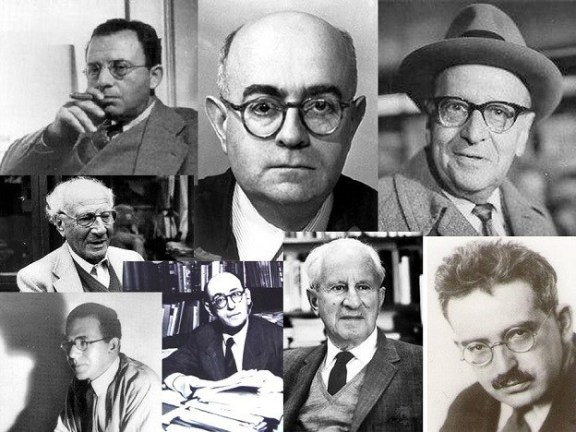
The institute’s founder was an Argentine-born Jewish millionaire named Felix Weil. Weil’s intention was to establish an institute similar to the Marx-Engels Institute in Moscow. The leading figures of the school were originally Max Horkheimer, Herbert Marcuse, Theodor Adorno, Erich Fromm, Leo Löwenthal, Friedrich Pollock, Franz Leopold Neumann, Otto Kirchheimer, and Walter Benjamin—all of whom were Jewish. The leading figure at present is the follower Jürgen Habermas2, who is not Jewish, even though his physiognomy and appearance might immediately suggest the opposite.
Initially, the school criticized political economy, but later concentrated on a more ideological critique. The central focus became the school’s so-called “critical theory.” Everywhere, they seek to break down and dissolve European values by denying any concept of authority and objectivity. The arguments are always vague, contradictory, extremely abstract and sophistical, destructive and corrosive. Traditional European Greek classical ideals of beauty, science, and harmony are quite foreign to these Jewish troublemakers, or rather: deeply hated. Hatred of everything characterized by beauty, refinement, honor, chivalry, and honesty is the unifying driving force. Added to this is an unbalanced, almost pathological glorification of non-European peoples and cultures, as well as a promotion of multi-ethnic and multicultural societies, which naturally comes at the expense of the traditionally predominantly ethnically and culturally homogeneous European nation states.
For a good 80 years, the school has been active in both Europe and the US without having made any real positive contribution to the advancement of science or civilization to date. The purpose of ideological criticism is to create confusion, dissolve and break down. By agitating for the “liberation” of all the world’s “oppressed” masses, they succeeded—especially Herbert Marcuse in the United States—in generating enthusiasm among young, confused, and inexperienced students. This led to the so-called student revolts of 1968. This, in turn, led to the proletarianization of universities. This in turn led to a proletarianization of public institutions and a vulgarization of the mass media, and thus to general dumbing down, cultural ignorance, selfishness, and indifference, which have contributed to enabling the mass immigration from the Third World over the last 30 years, which now threatens to bury all European culture and civilization. The old authorities, based on professional competence, were replaced by a new authority—political correctness, accompanied by intolerance and conformity, which is now paving the way for the downfall of Western civilization.
They succeeded in removing all the old liberal arts subjects from universities. In doing so, Western societies lost their heads and hearts. The universities are still there, but with a few exceptions, they have been transformed into large parasitic colonies, giant talking and rambling clubs. This is especially true of the humanities, and to a lesser extent the natural sciences, where Jewish left-wing theories are not so easily imposed. The taxpaying part of the population is being shamelessly exploited to an extent never seen before. Never before has so much money been given to “research.” In order to deceive the population, they appoint themselves as “experts.” This is done mainly through internal and mutual self-praise. You praise me, I praise you—the state treasury pays for the party. There are still standards, but these standards are set by political correctness, not scientific correctness. When a natural conflict arises between political and scientific correctness, the latter always ends up losing out. There are more and more examples of politically incorrect scientists of the old school being forced to leave their posts.
Seen in a larger historical perspective, the Frankfurt School is a classic example of Jewish intellectuals’ thirst for revenge and hostility toward traditional European culture and civilization. One can thus speak of a typical Jewish “culture of criticism” whose focus has been the negation of Western culture and civilization3. With the occupation and transformation of our academic institutions, the old Jewish thirst for revenge has celebrated its latest great triumph. Educated Greeks and Romans often warned against “the Jews’ hatred of the rest of humanity” – odium generis humani4. This is a minority problem among a highly gifted5 but strongly ethnocentric nomadic population group whose evolution, way of life, culture, and religion have always emphasized the group’s unique character and, as a result, the unfounded envy and irrational animosity of the rest of the world. This has intensified the group’s ethnocentrism and given rise to pronounced hostility and hatred towards the external groups among which the minority has lived6. In relation to the struggle for existence, this has quite naturally given rise to conflicts. “Anti-Semitism” thus often seems to be the result of real conflicts of interest in relation to competition for resources between Jews and their host peoples7. Jewish hatred has been directed in particular against the aristocracy of the host population, against the elite, the upper class, which also means against the traditional high culture, standards, and norms of Western societies. With great cunning, the thirst for revenge has repeatedly managed to whip up the masses as a tool to exterminate the aristocracy. For the working population, the thirst for revenge really only has contempt or indifference. It is only an instrument in the hands of the ethnocentric minority.
The Frankfurt School, just like Lenin and Stalin, wanted to proletarianize Europeans. The vengeful Jews were naturally expelled from Germany in 1933, after which they settled in the United States, from where they returned to Germany after the war. With the Allied occupation forces behind them, they now had free rein to “re-educate” first the Germans and later all potentially dangerous Europeans8.
The revolution of 1968 marks the proletariat’s final revenge and victory over the classical ideals, where personal and scientific education were central, which more than anything else has paved the way for Europe’s ongoing ethnic and cultural suicide. One can only hope that talented and brave scientists will strive, while there is still time, to enlighten us all about these serious problems and take a consistent stand against Europe’s declared enemies.
Notes
- “The Frankfurt School of Social Research and the Pathologization of Gentile Group Allegiances” (chapter 5) in Kevin B. MacDonald; The Culture of Critique: An Evolutionary Analysis of Jewish Involvement in Twentieth-Century Intellectual and Political Movements. ↩︎
- Jürgen Habermas is popular among Danish academics. In 1987, he received the Sonning Prize at the University of Copenhagen. In 2008, he was the guest of honor at the theologians in Aarhus, on whose website he is referred to as “one of the greatest thinkers of the 20th century,” etc., etc. In this context, he made himself interesting with paradoxical statements such as “We must recognize each other’s beliefs” and “We must tolerate what we reject.” The naive reader might get the impression that Habermas stands for great tolerance. But this is wrong, because if you look at what “one of the greatest thinkers of the 20th century” has otherwise put his name to, a quite different picture emerges. He once awarded the infamous Goldhagen a prize of 10,000 DM for Goldhagen’s foolish thesis that all Germans bore joint responsibility for the Holocaust, and he himself has received an award in Israel for his persistent efforts to prevent a free German historical-scientific discussion of the problems surrounding the Holocaust. Habermas is clearly not a supporter of objective historiography. When it comes to one’s own and others’ beliefs, some ideas are more reasonable than others: some believe that Jesus is sitting in the clouds, others that his mother was a virgin, that he himself walked on water. Habermas talks about “we Christians…” etc. – so is he himself a Christian? Let’s take the belief in the virgin birth – which is pure nonsense. Whether Habermas himself believes in such nonsense or not, he demands that we acknowledge or tolerate this absurd claim. We ask: why on earth? Perhaps he is so tolerant that he also wants us to tolerate the opposite claim – that Jesus’ mother was not a virgin. This brings us into conflict with a scientific principle – the law of contradiction, which states that one and the same thing cannot be both one thing and its opposite at the same time. We end up with a mother who is both a virgin and not a virgin, etc., etc. Habermas, who is both tolerant and not tolerant at the same time. The mother is half-virgin, and the man is a monster. This brings us to the heart of the matter. Habermas is not at all dismissive when it comes to awarding prizes, honors, cash prizes, free travel, etc., etc. He has clear personal values. With his paradoxes—the rabbis call it pilpul—Habermas wants to create moral and intellectual confusion. This creates “lucrative chaos” for himself and all the other theorists. ↩︎
- Kevin B. MacDonald; The Culture of Critique: An Evolutionary Analysis of Jewish Involvement in Twentieth-Century Intellectual and Political Movements. ↩︎
- Oskar Holtzmann; Neutestamentliche Zeitgeschichte. 2nd ed. Tübingen, Mohr, 1906. ↩︎
- Richard Lynn; The Chosen People: A Study of Jewish Intelligence. Washington Summit Publishers, Whitefish, 2011. ↩︎
- Kevin B. MacDonald; A People That Shall Dwell Alone: Judaism as a Group Evolutionary Strategy, with Diaspora Peoples. iUniverse, Bloomington, 2002. ↩︎
- Kevin B. MacDonald; Separation and Its Discontents: Toward an Evolutionary Theory of Anti-Semitism. AuthorHouse, Bloomington, 2003. ↩︎
- Kevin B. MacDonald; The Culture of Critique: An Evolutionary Analysis of Jewish Involvement in Twentieth-Century Intellectual and Political Movements. ↩︎
 Danmarks Frihedsraad