This article was originally published in Danish on December 11, 2024.
Georgia is an incredibly scenic country on the south side of the Caucasus – not in Europe. Like Moldova, it is a former Soviet republic and like Moldova, Georgia has problems with other peoples within its borders. The Caucasus is a patchwork of different ethnic groups, often speaking very different languages, belonging to very different language families1 and written with different alphabets. In other words, it’s a complicated area.
Georgia has – within its “internationally recognized” borders – approximately 3.76 million inhabitants on 69,700 mountainous km2. In addition to the Georgian territory itself, it originally consisted of the autonomous regions of South Ossetia, Abkhazia and Adjara.
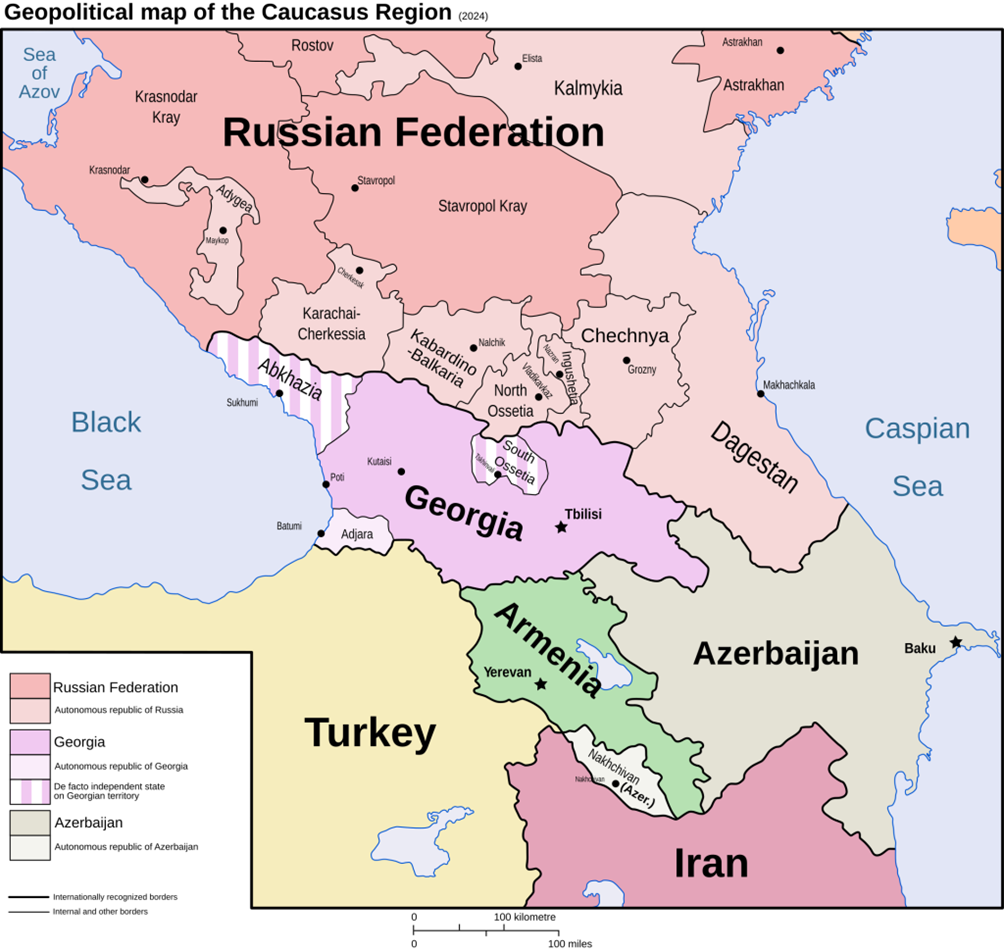
South Ossetia is populated by Ossetians, a Christian people who speak an Indo-European language of the Iranian language tribe (related to Farsi, Dari, Tajik and others). They are the same people who inhabit North Ossetia, an autonomous republic in the Russian Federation. The border runs along the mountain ridge. It makes sense geographically, but not when we talk about nationalities – which is what we do when we talk about nation states. A state is not primarily made up of a territory, but of the people who inhabit the territory. Borders that do not respect this relationship are not stable. When several peoples inhabit the same territory, it is a recipe for trouble. The South Ossetians want to unite with the North Ossetians in Russia, and South Ossetia has seceded from Georgia – just as Georgia seceded from the Soviet Union upon its dissolution, as the Georgian secessionist movement had been active for many years before the collapse of the Soviet Union. Today, South Ossetia is a de facto independent state recognized only by Russia, Nicaragua, Venezuela, Nauru, Vanuatu and Tuvalu.
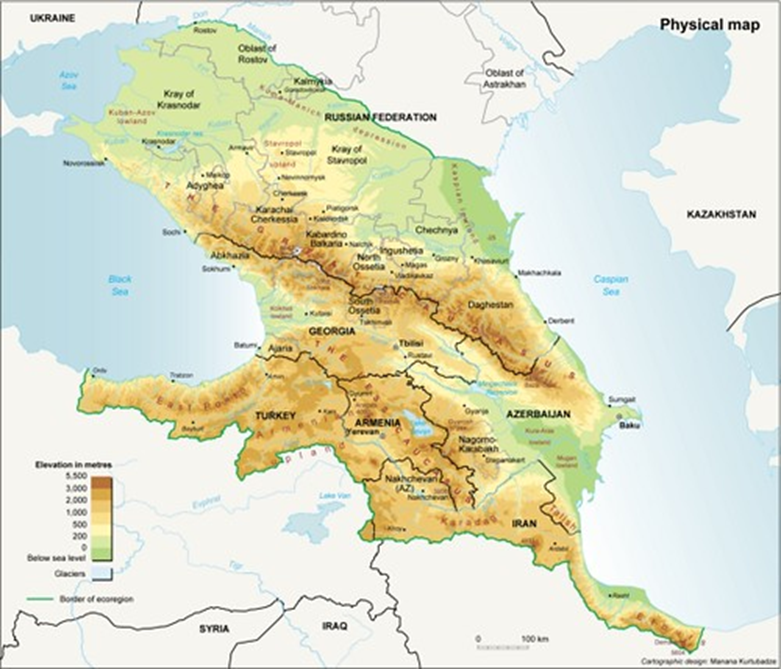
Abkhazia is the gut that stretches westward on the north side of the Black Sea. It was both an autonomous part of the Georgian Soviet Republic and an independent Soviet republic during Soviet times. When the Soviet Union collapsed, the Abkhazians seceded from Georgia. The population here is – or rather was – more mixed. The war of secession was even extremely bloody until Russia intervened and secured peace. As a result, there is still Russian military in the country and residents can get Russian passports. Many see it as part of Russia, but the recent political unrest in the country was caused by an attempt to prevent Russian oligarchs from buying up the assets of the Abkhazian nation. Abkhazia is de facto independent, but is only recognized by the same states that recognize South Ossetia. Its inhabitants are Muslim and speak a Northwest Caucasian language.
Adjara, with its capital Batumi, is beautifully situated on the Black Sea and enjoys a pleasant climate, and is inhabited by Sunni Muslim Georgians. They have not (yet) tried to secede, but there are secessionist forces – and the Turks also have their eye on the area.
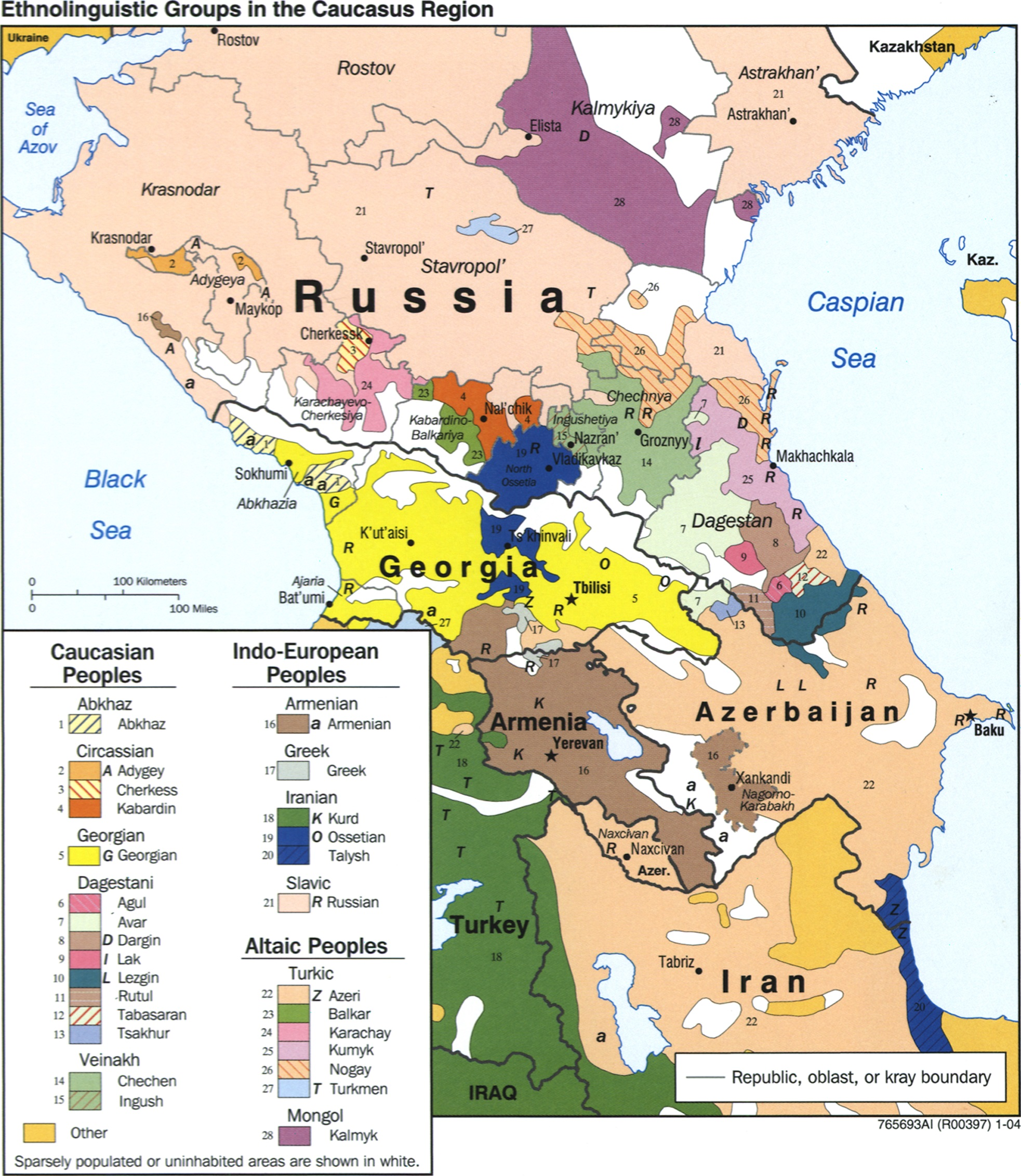
Georgia, within its “internationally recognized” borders, is, as you can see, a patchwork quilt. Georgians are an independent Christian people – one of the oldest Christian peoples. They speak a Kartvelian language with its own alphabet and, strictly speaking, with two different alphabets, one of which is currently only used by the church. In addition to Georgian, there are 3 other Kartvelian languages that are not intelligible to the native speakers. In addition, a wide range of minority languages are spoken, including indigenous languages such as the North-East Caucasian Tsova-Tush and the languages spoken by the many peoples bordering Georgia, whose borders are not drawn on the basis of nationality and where the freedom of movement in the Soviet Union has also made itself felt. There are Russians, Turks, Armenians, Azerbaijanis, etc. etc. in Georgia.
History has shown, not unexpectedly, that you cannot claim your own independence on the one hand and deny other peoples their independence on the other, and few places show this as clearly as in the Caucasus and most clearly in Georgia. Whether you like Georgia is a matter of taste. Let’s just say it is different and hating Russians is official state religion. On my last visit to Tbilisi, I had to resort to the Radisson to make sure my car was safe. It was fashionable to burn cars with Russian license plates. It is of course a nice hotel, but even in Georgia it is not cheap… The National Museum in Tbilisi is a long hate speech against the Soviet Union, Stalin and Russia. It’s easy to overlook the fact that Stalin was a Georgian – Georgia’s gift to humanity, so to speak. Some might say that Stalin was the prototype of a Georgian. People in the Caucasus generally have no kid gloves in their wardrobes, and wars and civil unrest in those parts take on dimensions of cruelty that we find hard to imagine. I have certainly met many friendly Georgians, and many have emigrated to Russia, where they typically open a restaurant. Georgian cuisine is to Russia what Italian is to Denmark. I prefer Italian, but since my favorite hotel in St. Petersburg has a Georgian restaurant, I eat a lot of Georgian food. It’s very good, and the wine is especially good.
As you can see, there are many different cracks in Georgian society – and such a society is fertile ground for the CIA. It is not difficult to create unrest in Georgian society, and US dollars provide easy access to useful idiots and subversive elements that can hide in US-funded so-called NGOs. One such useful Americanized idiot was Mikheil Saakashvili, who easily won the presidency with his dollars. The lost territories of South Ossetia and Abkhazia were bleeding wounds for the Georgians, and in 2008 an attempt was made to achieve reunification through negotiations. The mediator was Russia, which also had a UN mandate to have peacekeeping forces in what the Georgians considered occupied territories. However, America had targeted Georgia as a battering ram for encircling Russia. Georgia was promised both EU and NATO membership, and the US secretly persuaded Saakashvili to give the negotiations a good day and instead launch an attack on South Ossetia and Abkhazia to seize the territories. During the attack, a number of Russian peacekeepers were killed. They had poked the bear in the eye and within a week Georgia had to capitulate. An extra piece of Abkhazia was lost in the process. There have been no diplomatic relations between Russia and Georgia since then.
However, Georgia is divided over its relationship with Russia and the war in Ukraine has sharpened the differences between those who want to live in peace with Russia and those who want to share fate with Ukraine. The government wanted peace and to stem American attempts to organize a color revolution with “regime change” in the country, a law was passed stating that organizations that receive more than 20% of their income from abroad must register as foreign agents. The press contemptuously calls this ‘the Russian law’, but it should be referred to as ‘the American law’, because in the US, anyone receiving foreign funding must register as a foreign agent. We recently saw how Scott Ritter’s home was turned upside down by the FBI and all his electronics seized because he was suspected of being a Russian agent without having registered – yes, they even took away his passport. It’s called intimidation – and it affects independent journalists like Scott Ritter, former UN weapons inspector in Iraq. His broadcasts are highly recommended.
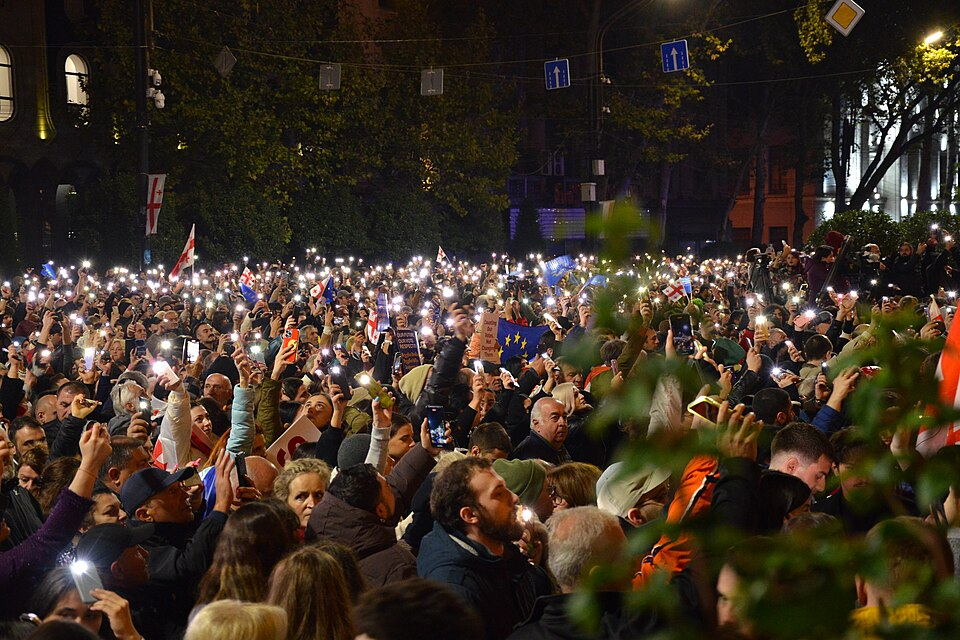
The passing of this law naturally led to the usual demonstrations, but the recent elections still gave the peacekeeping wing a narrow majority – which naturally led to the wing that wants war – and thus the destruction of Georgia – refusing to recognize the election results. Again, there is no limit to the amount of US dollars put into circulation. There is no factual basis for contesting the election results, and the opposition should just go home and accept the “rules of democracy”. This is what they did in Moldova, even though the election result there was demonstrably the result of massive electoral fraud. They had no American money to demonstrate for.
The President of Georgia is French (with Georgian ancestors who emigrated after the 1917 revolution and supported the German invasion of the Soviet Union in 1941). She easily obtained a Georgian passport and today has dual citizenship. Like Zelensky, she refuses to resign at the end of her term and the civil unrest is approaching a civil war that Russia will have to intervene in – which is precisely the US’ purpose in this exercise at this time. They want to open a second front against Russia in order to weaken Russian efforts in Ukraine.
Even more worrying is that observers believe that the rockets that caused major damage to the Russian naval station in Novorossiysk were probably fired from Georgian territory. If the Russians come to that conclusion too, World War III is underway. The Russians know that it was not Georgian missiles but American ones that were used. We live in exciting times….
If the world wants peace, America must be destroyed! But hopefully they will do it themselves!
Povl H. Riis-Knudsen
Translated by means of AI
- Anyone wishing to familiarize themselves with some of the details concerning the inhabitants of the Caucasus is referred to Lars Funch Hansen & Helen Liesl Krag: Nordkaukasus. People and Politics in a European Border Region, Museum Tusculanums Forlag 2002. As the title suggests, it deals mainly with the North Caucasus, i.e. the Russian part of the Caucasus, but the same conditions apply to some extent in Georgia ↩︎
 Danmarks Frihedsraad