This article was originally published in Danish on November 25, 2024.
Moldova
Moldova is a scenically beautiful but by no means spectacular country, sandwiched between Romania and Ukraine1. It’s not really a country, it’s a province of Romania, formerly known as Bessarabia. Due to its exposed geographical position on the map, Bessarabia has led a very changeable existence, soon Romanian and soon Russian. It only became independent after the collapse of the Soviet Union.
It is the second poorest and most uninteresting country in Europe. Only Ukraine is poorer, but far more interesting. Ukraine has plenty of riches in the ground and is a fantastically rich agricultural area, and it should be the richest country in Europe. When it is not, it is due to ineptitude and corruption as we see it manifested in the current top – and its connections to the Biden family. Moldova only has the corruption – not the natural wealth. It grows good wine – and other agricultural crops, but so many people do. Bessarabia originally had a German-speaking minority, but it was taken “heim ins Reich” by Hitler when he handed the area over to Stalin. That leaves the Gagauz, a Christian people who speak a Turkish language and have their own non-contiguous autonomous region – and Transnistria. Stalin didn’t like ethnically and linguistically homogeneous sub-republics, so a thin strip of land on the other side of the Dnester River was added to the Soviet Republic of Moldova. And the people here are not Ukrainian – they are Russian, just like their neighbors in Ukraine – the whole stretch down to the Black Sea and even Odessa is Russian-speaking.
There are many in Moldova who are in favor of incorporation into Romania – the population is Romanian and speaks Romanian in practice, although the language in Moldova has absorbed some Russian foreign words that are unknown in Romania – but of course there has also been an influx of people from the other Soviet republics. However, Romania is also a poorhouse – so why not keep its independence (Bucharest is far away!) and seek direct membership of the EU. It’s an idea that has grown up in Brussels – not in Moldova. People in Transnistria don’t like either idea, including an independent Moldova – they are Russian, they speak Russian – and they want to be part of Russia. Ergo, as a first step, they declared Transnistria an independent state back in 1990. This led to civil war, the deployment of Russian peacekeepers (with a UN mandate) and de facto independence for the area east of Dnester and the town of Bender on the west bank. It’s a quirky state with its own currency, police etc – and its own – Russian – identity with an external tinge of Soviet nostalgia. There is no heavily guarded border, as is often claimed, but there is Transnistrian passport control. If you drive through Transnistria to Ukraine, you have to look for the Moldovan passport control in a small shed in the Ukrainian border station area to get your exit stamp in your passport – important if you plan to visit Moldova again.
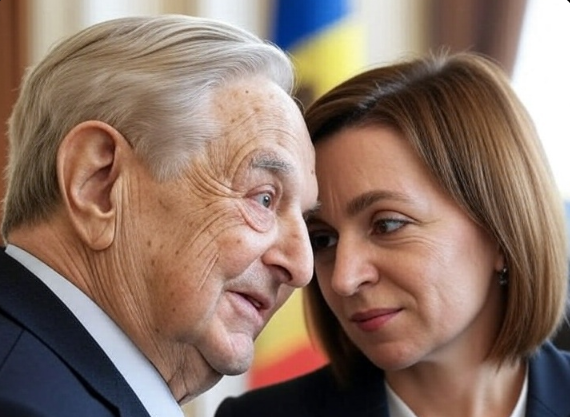
Of course, the EU found a willing and probably well-paid tool in the nullity Maia Sandu – another of those stupid women who make European politics an infantile tragedy. Maia has just held a referendum on whether to enshrine the effort to join the EU in the constitution and then a presidential election. The people of Moldova said NO in the referendum and NO to Maia Sandu, but Moldovan citizens living abroad still have the right to vote in Moldova and they reportedly voted YES to both, which does not significantly affect them personally. The majorities were not impressive. It was deliberately made difficult for people in Transnistria to cast their vote, even though they were eligible to vote. There were only a few polling stations near the border – and of course none in Transnistria itself. The Moldovan diaspora falls into 2 main parts: the EU countries and Russia. 231 polling stations were set up abroad (e.g. 60 in Italy, 26 in Germany). In Russia, 400,000 Moldovan citizens live and work. For them, 2 (two!) polling stations were set up, both in Moscow. Many Moldovans work in the industries in Siberia. A Moldovan businessman chartered a few planes to fly voters from Siberia to Moscow. This is described by Sandu and the Western press as “Russian interference”. The lines in Moscow were kilometers long. But it didn’t matter. Only 3,000 ballots were sent to Moscow for the referendum, for the presidential election reportedly 13,000. That’s how you do it. It was well known that Moldovans in Russia would vote against the EU and Sandu.
Sandu started all sorts of rumors about Russian interference. Her Gagauzian opponent was described as a Trojan horse for Moscow and voters were asked if they wanted a “Turk” as president. Moscow was also accused of buying 300,000 votes – how to do that in a secret ballot. There is not a shred of evidence for any of the allegations. But the EU intervened heavily – partly, of course, with ample funds – but also with a stream of EU politicians who probably had to find Moldova on a map first. The wandering beer barrel and foreign minister from Denmark also made his presence felt. They were there to demonstrate the EU’s unconditional support for Sandu and her project. As a taxpayer in the EU, you have to ask yourself what interest the EU as an organization can have in admitting yet another poor country to the association. Moldova has absolutely nothing to contribute! Europe’s poor have already had to pay for infrastructure and huge bureaucracies throughout Eastern Europe. Poland’s highways are of a far better standard than highways anywhere in Western Europe – but we paid for them.
These elections were fraudulent – no one doubts that – but there have been no large American-funded demonstrations demanding re-election. This was a bought election result. The so-called democracy is a sham.
However, there is no doubt in my mind that Moscow has taken note of this. It is another incentive for the Russians to continue along the Black Sea coast, liberate Odessa – which has always been a Russian city – and walk the last 100 kilometers to Transnistria, which has applied to join the Russian Federation. Then it will be time for Moldova to decide whether it wants to be a new Ukraine or not.
Povl H. Riis-Knudsen
Translated by means of AI
- Moldova’s changing history and identity problems are extensively (416 pages!) discussed in Matei Cazacu and Nicolas Trifon: Republica Moldova – Un stat în căutarea naţiunii (Republic of Moldova – a state in search of a nationality), Editura Cartier, Chişinău. Translated from French: La République de Moldavie. Un état en quête de nation. ↩︎
Election theater articles
 Danmarks Frihedsraad