This article was originally published in Danish on September 25, 2024.
After about a year’s absence, I finally came back to Russia, and after a three-week stay in Belarus, which will be reported on later, I decided to drive to Crimea and Donbas. It is one thing to listen to the numerous reports from the front – it is another to be there myself. We know that the official press is just a propaganda outlet, but it is lying even more than we think. The reason, of course, is that no one really knows anything about Russia, Russian history, Russian society – and no one understands the Russian mentality. You can tell people just about anything, and they will believe it. Of course, our under-educated politicians know nothing at all, so they hire various advisors who also know nothing. In a world bristling with nuclear weapons, this is extremely dangerous because they are unable to decode Russian signals – and the lack of any practical military training also means that they do not understand the dynamics of war – and the mathematics of war. This leads to very dangerous fallacies, which together with a lack of basic human intelligence and ideological blindness can lead us into a devastating nuclear war.
The attitude towards Russia dates back to the days of Communism. Back then, the Soviet Union wanted to bring about a world revolution, and in the West, we were not so keen on that. Today, I have come to the regrettable conclusion that Communism, though unpleasant, would have been much better than what we have now. However, this is a different discussion. Vladimir Putin has no world revolution on his program. Mette Frederiksen, the prime minister, God help up, and her ignorant cronies believe that Putin will occupy us if Ukraine does not win its hopeless war. There is no evidence for this crazy idea. Why would he want to do that? If Putin has an ideology, it is the ideology of Russkij mir, the Russian World. Unfortunately, we are not part of that so there is no chance that he is going to liberate us from American degeneracy. He sees Russia as the protector of all Russians, wherever they may live. Russians generally have no problem living outside Russia – as long as they are allowed to be Russian, speak Russian, go to the Russian church, send their children to Russian schools and watch Russian television. For countries with large Russian minorities, the message is quite clear. Go easy on your fellow Russians – be good to them and you won’t have any problems with them. But if you treat them like third-class citizens and demand that they stop being Russian, then I predict you will have problems. This is directed specifically at the Baltic States, above all Estonia and Latvia. A dangerous policy is being pursued there that is bound to end badly.
The idea of protecting minorities abroad should not be so far from our minds. We maintain a Danish school system, Danish kindergartens and a Danish church in South Schleswig – and we support Danish associations in the region. We are not a superpower, but we would probably protest if the Germans closed all that and ordered people to speak German and only German. This situation would be very similar to the situation for Russians in Ukraine – and increasingly so in Estonia and Latvia, where there is the added twist that both states would collapse if their Russians packed their bags and went home to Russia. They make up between 30 and 40% of the population in these countries, as they did in the former Ukraine. And they are the best educated part of the population.
We also maintain a Danish church in Buenos Aires and a Danish retirement home in the same place, and we support – to a modest extent – Danishness in Argentina and many other far-away places where Danes have settled. This is just for comparison.
Yes, in fact, the protection of national minorities is part of the EU legal framework and various international conventions.
Russia is big enough. Russia has everything in terms of food and raw materials. What would Russia want here? What could they find here that they don’t have themselves? Only decadence, depravity and incompetence. There is nothing here that decent and educated people can use for anything. And then there’s the math – something you don’t learn in school either. There are probably 150 million Russians at most. If Russia were to incorporate the rest of Europe, Russians would become a minority in Russia – a small minority. It’s completely idiotic to think that this would be in Putin’s interest. And while we’re on the subject of math: Could Russia chew off and digest this much? This is where the math of war comes into play. There are over 500 million people in our part of Europe, and even though most of them are probably not good for anything – especially not as soldiers – it would be a big mouthful. Granted, Russia is technically superior to us, but still. It’s the same math that means Ukraine can‘t beat Russia – and that Hitler couldn‘t beat the Soviet Union.
But at the same time as we fear Russia’s strength, we are told in no uncertain terms that Russia is weak and cannot win the war against much smaller and poorer Ukraine. It has taken them almost three years to gain a few square kilometers, and now look at Kursk. According to the Western press, you would think that the Ukrainians were standing at Moscow’s gates. They are not, but we should remind our readers that others have been standing at Moscow’s gates and have yet suffered a humiliating defeat…. If NATO (i.e. the US) inflicts World War III on the world, it will almost certainly lead to a nuclear war, because no nuclear power will allow defeat, and the US only has the atomic bomb as a response to Russia’s superior technical development. Russia has developed bombs with the explosive power of a medium-sized nuclear bomb – but without the radioactive fallout.
We’re used to reading about how the US drops a few bombs and moves in to defeat an army of shepherds in sandals with old machine guns in hand. It’s fast-paced, yet the US has always left with its tail between its legs, leaving chaos, death and destruction in its wake. This is the pattern from the Korean War onwards. Russia has plenty of time. They had the Mongols for centuries. Russia is waging a war of attrition and it’s almost there: the demilitarization of Ukraine. Ukrainians casualties are currently enormous: between 2,000 and 3,000 men a day. The front is collapsing around the ears of the Ukrainians, who have foolishly sent their best and best-equipped forces to Kursk, where the Russians are simply exterminating them. They can’t run anywhere; the Ukrainians keep sending reinforcements – that all perish. This is what happens when amateurs want to wage war – we’ve seen it before. Neither painters nor actors should play army commanders. What we are witnessing today is reminiscent of the last days in the Führer bunker in Berlin in April 1945. In Kiev, Zelensky is also totally divorced from reality!
Another reason for the slow progress is that the Russians avoid waging war against civilians – and that a large part of Ukraine’s residents are Russian – something the West deliberately ignores because it doesn’t fit the narrative. Russia could do what Israel is doing in Gaza and Beirut – but they leave attacks on civilians to the Ukrainians. The Ukrainians are not just an abstract fraternal people. The two are so intertwined that most Russians have Ukrainian relatives. Russians have no hatred for Ukrainians, while Zelensky and his junta engage in constant propaganda against the “Russian sub-humans” – something I seem to remember from the history books and which is delivered in a style and tone that would be punishable in any West-European country. When traveling in and out of Russia – be it through an airport or across a land border – the amount of travelers with Ukrainian passports is quite significant. They are checked, of course, but they are treated exactly the same as everyone else. No one is blaming them for the British-American war on Russia. Russians know perfectly well that Ukrainians are just the hapless victims of America’s quest for world dominance and that Zelensky and his gang are just paid henchmen. No one in the West – as in absolutely no one – is thinking about the Ukrainian people. There is abstract talk of ‘Ukrainian sovereignty’, but what defines a nation state? Is it a random territory – or is it a people sharing a common language, culture and way of life? The dissolution of the Soviet Union paid no attention to the lessons of history. Just like after the First World War, a myriad of small and large states emerged with quite significant national minorities – and with territories where these minorities were a majority (just like Memelland, Danzig, Sudetenland, etc.). The consequences were predictable, but the problems might have been solvable if the US had not interfered in the internal affairs of these states – without understanding these states and their innate problems. The US political “elites” never understood other countries. They live inside the beltway and are only aware of their own mighty power.
The West fantasizes about “colossal” Russian losses, for which there is no evidence. It’s another old myth from Stalin’s time that the Russians don’t care about their soldiers. This is as far from the truth as can be. Soldiers have hero status in Russia and the reasons for caring about their lives are many: demographics (there are far too few Russians), economics (large sums paid to bereaved families – and to new recruits), high costs for training soldiers, and simply the danger that the support of the population could suffer if there are too many casualties. Some like to compare this conflict to Russia’s war in Afghanistan, but this comparison has no foundation in reality. The Russians could not see any sense in their military presence in Afghanistan. However, everybody knows why the war in Ukraine is necessary – and in case anyone has forgotten, the Kursk invasion has reminded them.
There are constant attacks on the border regions of Russia – there have been since 2014. An estimated 14,000 people had been killed when Putin decided to conduct the special military operation1 which was anything but unprovoked. The Zelensky regime is not going after military targets, but there are still civilian victims of random terror every day – because that’s what it is. The other day they sent a drone straight into an apartment block in Saratov on the Volga (that’s well inside Russia). A few days ago, a block of flats in Moscow was targeted. Deliberate terror against civilians – and Mette Frederiksen is complicit in these murders. I am looking forward to a Nuremberg Tribunal 2.0… I hope I shall live long enough to witness the executions.
When I arrived in Moscow on July 7 after spending a good month in Armenia and Iran, I could sense a certain fatigue in the population. Nothing was really happening. It was the same people saying the same things on television. But then Zelensky came to Putin’s aid. When the Ukrainians moved into Kursk, the mood changed overnight. Now it was the motherland that was attacked. Now people want war to finish off Zelensky and his gang of criminals. Zelensky is a fool. He can achieve nothing by occupying a sparsely populated area in a far-away Russian province, but he has waked up a bear in the middle of its hibernation, and my guess is that the Russian troops will not stop until they reach the Polish border. Zelensky wants to be allowed to use long-range Western weapons against targets in Russia – but that won’t solve his problem. He has no more people to put through the meat grinder. So while Zelensky is terrorizing civilians in Russia, Ukraine is being wiped off the map. A Ukrainian buffer state with a Russian-oriented government will probably be created, but the current Ukraine will hardly survive. Had Ukraine honored the Minsk agreements, the country would have remained intact and there would not have been more than 1 million casualties and 12-20 million refugees, most of whom are unlikely to return. After the talk of the West of sending back Ukrainian refugees for military service, there is a queue at the Ukrainian consulates: People want to be released from their Ukrainian citizenship! They will rather be stateless! So much for the highly praised Ukrainian enthusiasm about defending their country! Had they stuck to the accords, they would only have “lost” Crimea, which has never really been Ukrainian. Khrushchev moved the peninsula to the Ukrainian Soviet Socialist Republic in a state of drunkenness in 1954. Before that, Crimea had been Russian and it was inhabited by Russians – and it still is! Anyone today who sends arms and men to Ukraine under the pretext of ‘helping’ the Ukrainians is only contributing to the destruction of the people, the country and the language.
I have visited Crimea before, but by plane. By land via the Kerch Bridge, it’s about 1,800 km from Moscow – that’s a 3-day drive. The main road south (which is being developed into a toll highway) is heavily trafficked, so it’s not a relaxing drive. The first station was Voronezh, which is a large and quite nice Russian provincial town. It lies within the zone subject to regular drone attacks by Ukrainian terrorists. At our usual hotel, the first thing we were handed were instructions on what to do in case of an air raid warning. There was none that night. The next station was Slavansk-na-Kubani, west of Krasnodar. It’s a small, neglected town in a somewhat neglected but very lush corner of Russia, known for its excellent wine. Before the construction of the Kerch Bridge, not many people came here – and people still don’t. Due to the war, the bridge can only be used by passenger cars, and the queue for the security check is 2½ hours long. Today, it’s easier to use the Rostov-Taganrog-Mariupol land bridge to the Crimea, but the bridge was built in different circumstances. Now, only traffic to and from the far southwestern corner of Russia can save kilometers and time enough to make it worthwhile using the new bridge, which is located about 350 km west of Krasnodar. Distances in Russia are considerable. Then there is the road connection. Together with the bridge, authorities constructed 60 km of beautiful motorway – today without much traffic. But before you get to it, however, you have to take the tertiary road network, which is surprisingly busy with long queues in places. Today, the bridge is more symbolic than practical – and the symbolic value applies to both parties. When the Ukrainians dream of bombing the bridge again, it is pure terror. And when Boris Johnson today calls for its destruction, it shows that he knows and understands nothing – he is just an unintelligent terrorist. The bridge means absolutely nothing to the war. There are no military or supply transports going that way. If they don’t use the road via Mariupol, they take the ferry, which is still running. Boris Johnson is the father of this war; he has a million lives on his conscience – and they have fallen for absolutely nothing. If you want to apply the principles of the Nuremberg Tribunal, the gallows will be waiting for him, too.
The Crimean peninsula has a mountainous and very beautiful southern coastline along the Black Sea, while most of the northern part of the peninsula is flat farmland. The capital Simferopol is located inland and is not the most exciting city in the world, but its parks make it quite pleasant, even if it is very hot in summer. There has been a rapid development since I first visited Simferopol 5½ years ago. Back then, the Ukrainian heritage prevailed, characterized by the lack of maintenance, dirt and remnants of Ukrainian squalor. People who have never been to Ukraine do not understand that Ukraine is what is called “a failed state”. The abysmal corruption and political chaos that still prevails has stood in the way of real economic progress. On the list of countries with the most raw materials in the world, Ukraine is No. 5. It should have been the richest country in Europe, but it is the poorest. The standard of living before the war was noticeably lower than in Russia – and all infrastructure was in poor condition. The building stock in the major cities was ripe for redevelopment. Only the central parts of cities like Odessa and Kiev had been restored.
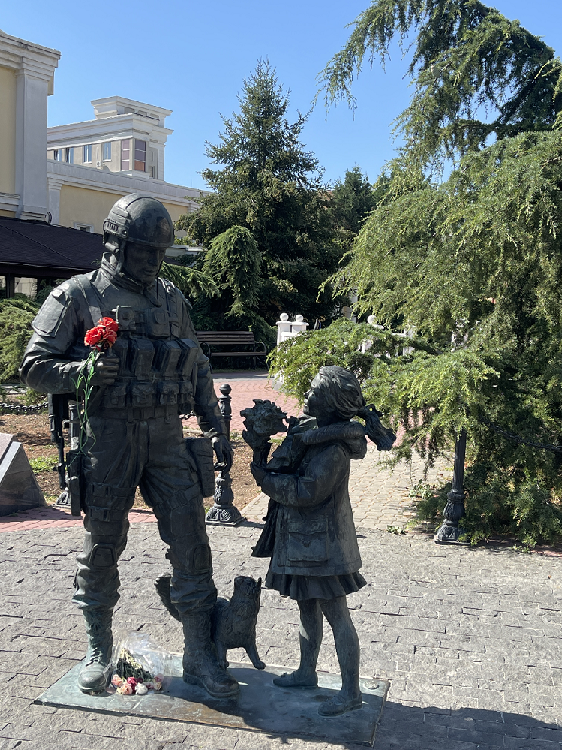
Simferopol, in front of parliament – notice the flowers!
Crimea had already been granted the status of an autonomous republic in Ukrainian times, covering the entire peninsula except Sevastopol, which had a special status due to the Russian naval base. After the US-organized coup d’état in Kiev in 20142 Kiev seceded from Ukraine and, with a little help from Russia, defended its independence until it later applied to join the Russian Federation. This was not an “annexation”, but a secession by the book. Putin is not a lawyer for nothing. There have never been many Ukrainians living in Crimea. On the other hand, there are some Crimean Tatars, who grew up hating Russia, because Stalin had them deported from Crimea. They mainly live around Bakhchysarai, which is on the road between Simferopol and Sevastopol and is definitely worth a visit. The Crimean Tatars are Muslims and there are several mosques, especially in the central part of the peninsula, including Simferopol. At least 85% of the peninsula’s population is Russian, so it’s ridiculous to hear Zelensky talk about liberating the oppressed people of Crimea who have supposedly had their lives destroyed. Crimea today is in a much better state than it was under Ukraine and the quality of life in Crimea is extremely high. That Zelensky is lying is hardly surprising – but that anyone believes him is based on a catastrophic lack of knowledge. By the way, Crimea has three official languages: Russian, Ukrainian and Crimean Tatar. All three can be used with the peninsula’s authorities. This is in stark contrast to Ukraine, where you can now only use Ukrainian, even in areas where the population is purely Russian. Today, there is practically not a soul in Crimea who wants to return to Ukraine, including the few Ukrainians who may be in the very northernmost part. I have not managed to find a single one!
Sevastopol is a proud, beautifully situated, and very nice city – one of the hero cities of the Soviet Union. For the tourist, it has a lot to offer, starting with a boat trip in the harbor area and a visit to the historic underwater submarine base, which the Ukrainians opened as a museum. Well, it wasn’t a secret anymore after the Germans were in Crimea, and it had become obsolete as the submarines grew in size, but it still annoyed the Russians. This facility, however, is one of the most impressive pieces of engineering I have ever seen. It’s on par with the pyramids and the Great Wall of China. Then there’s the ancient Greek city of Chersonesos and a panorama of a battle in the Crimean War (1853-56) – not one of the highlights of Russian history. There’s also a naval museum and a number of other museums. We had long since visited these places, so now it was more about recording how people live so close to the war. This was illustrated brilliantly during dinner on the terrace of the Sevastopol Hotel, which faces the bay and offers a beautiful view. Suddenly, two short machine gun salvos sounded very close by. Then the air defense went into action with 10 minutes of cannonade. Finally, a missile was fired, and something blew up, causing a series of small explosions. I couldn’t see what they were shooting at, but the position was hardly more than 300-400 meters away. Apparently, they had hit what they wanted, and now the shooting moved to the next battery further down the coast. We all continued eating peacefully – no one raised an eyebrow or stopped the conversations at the tables. This was everyday life in Crimea. Only when the gunpowder smoke drifted across the terrace did some people move inside. It irritates your nose.
The pearl of Crimea is Yalta, a small town built on the mountainside. It is a motorist’s absolute, unrivaled nightmare. We settled in Hotel Oreanda, the city’s old Nobel Hotel, which today has a number of competitors and whose kitchen is no longer what it was just 5½ years ago. But the hotel is practically on the promenade along the Black Sea, which is just as crowded as a department store on the first day of the summer sale. Yalta is also extremely nice. It was here – in Livadia – that the Tsar had his summer palace, where the Yalta Conference between Stalin, Churchill and Roosevelt took place in 1945 and where they decided to divide Europe between them. In the surrounding area, there are several palaces where tsars and magnates used to spend their summers. The writer Anton Chekhov also had a house in Yalta, where there is now a museum. And of course, Zelensky, too, had his summer residence here – but it has now been sold by the authorities.
The last stop in Crimea was Feodosia, where author Alexander Grin lived. His romantic tale Alije Parusa from 1923 (filmed in 1961) about the girl Assol, who has been foretold that she will be picked up by a prince in a ship with red sails, which after many years of hardship and waiting finally comes true. The story has given its name to the tourist complex where we were staying, and a model of the ship with the red sails now sits on my bookcase – a gift from the hotel. Feodosia is also an industrial town and is marred by the fact that a railroad runs on an embankment along the shore. But even here there are a number of nice places, and the hotel was definitely in a class of its own – and at a price that you can only dream of in Copenhagen.
After a short visit, we continued via Dzhankoi to Melitopol and Mariupol, one of the places where the war raged most violently. The city’s main workplace was Azovstal, a combination of a mine and a steel mill where Ukrainian terrorists had housed in four-story underground mine tunnels and forced the city’s population down with them as hostages. Azovstal is a huge area of twisted metal, rubble, railroad cars, etc. Cleaning it up will take many years. Volunteers have already started slowly. Weapons, ammunition and bodies are found every day. My companion remarked that it smelled of death – and she was right.
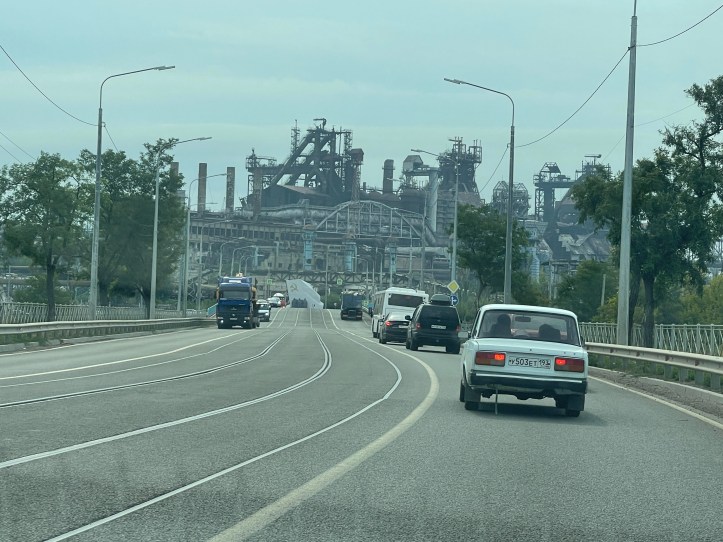
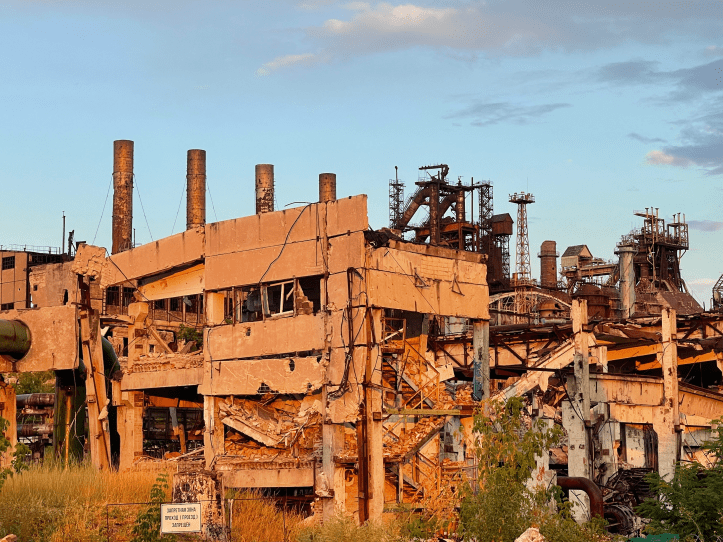
Azovstal
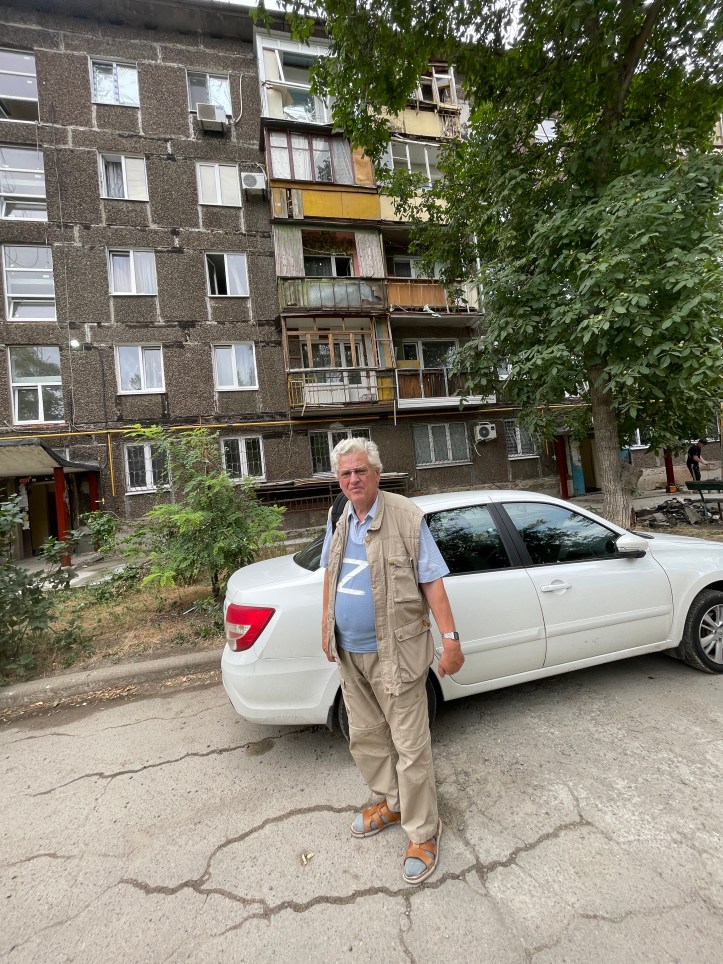
The city itself is also a pile of ruins. Some new apartment blocks have been built, a single street has been restored in places. There are a few restaurants, but no functioning hotel. As there is a curfew at night, we had to find a place to sleep. Somebody knew where there was a microscopic apartment for rent by the day in what can only be described as a ruin. It was a Khrushchev-time construction of the lowest quality, what is known in Germany as Plattenbauten, basically stacked concrete slabs. Although the neighborhood was relatively intact, it had been badly damaged. The slabs had obviously shifted. There was only light in the apartment itself on the 5th floor with the help of a cable pulled from outside, not on the stairs. The balcony had been blown off, the windows were new. In addition, the bedding was full of bed bugs, but that was hardly the fault of the war. That vermin can withstand anything. But at least it was partly indoors. It was obvious that these blocks would be restored. In fact, they probably should have been demolished. Otherwise the city looks like Berlin in 1945. You can restore and build new, but where are the jobs? They’re gone until Azovstal can be put back into operation. But of course, there is also a lot of work in the construction industry – at least for a while. And for the record, people here are also Russians, not Ukrainians – and they do not want to be “liberated” by Zelensky under any circumstances.
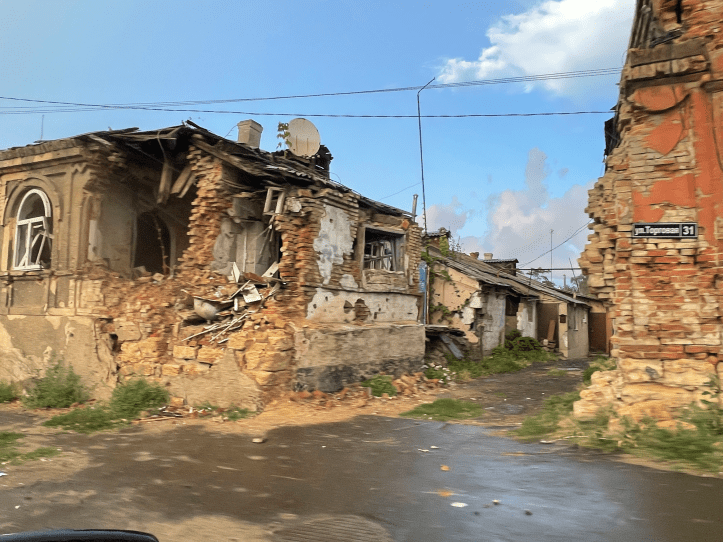
Top: Mariupol
Middle: In front of the nice side of our sleeping place in Mariupol
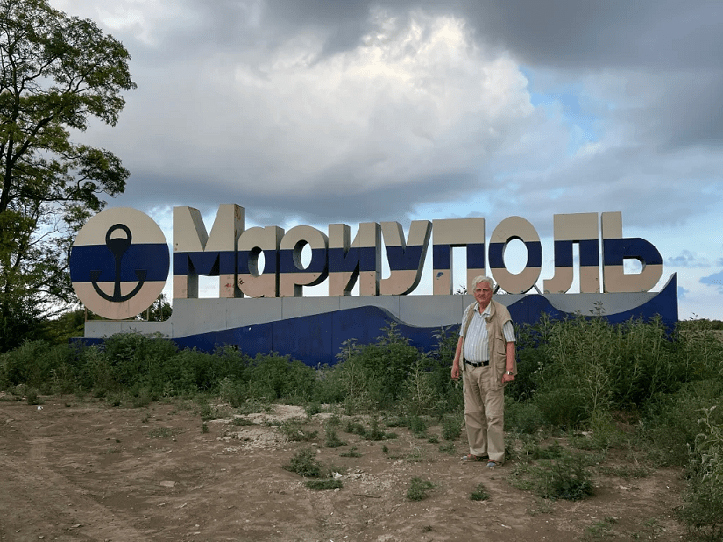
Bottom: Mariupol city sign
One reason why the Russian liberation of Donbas is taking so long is precisely because of the topography, with its many hills and countless mines and associated slag heaps. The Ukrainians have had since 2014 to expand their positions, and the landscape is ideal for that – and so are the mines. The Russians advanced quickly in the flat southern part, where they are today outside Kherson and not far from Odessa. That landscape is difficult to defend. Once the last resistance in the Donbas is defeated, there is nothing to stop the advance until you get to the Dnieper. This is the Ukrainians’ last chance to keep some of Ukraine. If by then they are still unwilling to negotiate peace on a realistic basis, the Russians’ next stop is the Polish border. The road there also goes through flat land.
The main city in Donbas is Donetsk, and thanks to the many industrial companies in the area, it was not a poor city – nor does it look poor today, but it is not far from the frontline and has been shelled daily since 2014 with many casualties. It is a surprisingly neat and pleasant city where life seems very normal. Both the town and the cafés are full of life – and soldiers. As mentioned, the frontline runs just outside the city and the hotels are used by the military. After some time in battle, the troops can rest here before going back into action. We settled in at the Donbas Palace, where you are greeted by a sign with a machine gun with a line through it and a reminder not to bring weapons inside.
Most of the city’s western hinterland is scarred by war and fighting. The road towards Seversk has been partially blown up and destroyed by tank traffic. The bridges have been blown up. The road is actually four lanes, but you drive in a single lane that switches from side to side depending on where it is reasonably passable. You don’t want to stop and get out of the car to take a leak. There are landmines. We really wanted to go to Artyomovsk (which the Ukrainians called Bakhmut), but there are not really any updated road maps, and the GPS has been jammed. We drove through 3 military checkpoints. At the fourth, the guard asked where we wanted to go. We wanted to go to Artyomovsk. He shook his head. We couldn’t get there that way, and if we continued past him, we were going into the war, so unless we had an important errand, he would suggest that we turn back. We did, but we had gotten a good impression of how devastating this American war is. Sometimes I really wish that somebody would take the war to America – just a few conventional bombs would scare the living bejesus out of the Americans! They have recked havoc around the world and have killed millions of people, but they haven’t had a war at home since 1865 – they don’t know what it is! But maybe they will have another civil war soon. I hope so! Another drive was to Saur-Mogila, a majestic hilltop monument, a huge burial mound in the southeastern part of Donetsk Oblast (today Donetsk People’s Republic), close to the border with Rostov Oblast. In the 1960s, a memorial was built here for those killed in one of the many battles of World War II. During the current war of liberation, the mound was also the scene of battles and changed hands several times. Today it is liberated territory, and the monument has been rebuilt to include the fallen of the current war and this has been done in a brilliant way. The Russians are really good at monuments. As you walk up the stairs to the top, you pass a series of reliefs where past and present merge. The liberation struggle is continuous. What at first glance looks like rust on the figures in the old uniforms is not rust, but the symbol that the past may fade away, but it is not forgotten because the torch goes on. The monument is a popular destination and from the top there is a fantastic view. Many soldiers come here – and there is room for more names on the stones. But I fear that more stones will also be needed…
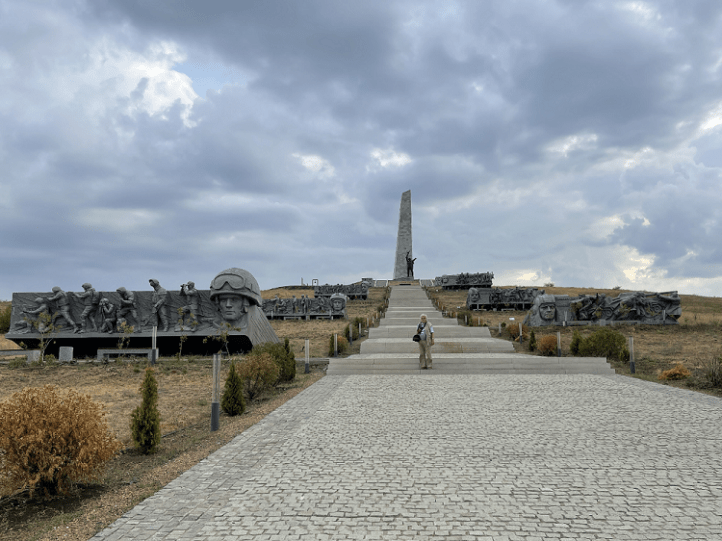

Top: Saur-Mogila
Bottom: Recruitment poster
Our next stop was Lugansk, which is a completely different kind of city from Donetsk. It is smaller, but above all it is poorer, a classic workers’ town – and the Ukrainian government has maintained absolutely nothing. Even inside the city, the streets are impassable in places. I don’t know when the last tram ran, but it’s been a long time. The tracks are still there, and where there are tracks, the asphalt deteriorates when it is not maintained. In Lugansk there is no immediate war damage to be seen. Here you are further from the frontline. There is a good straight road from Donetsk to Lugansk, but before you go anywhere you have to ask about safety. We were sent in through the villages. The main road could be fired upon. From Lugansk we drove north to Severodonetsk, also located in Lugansk oblast (Lugansk People’s Republic). The city was liberated by Russian forces after heavy fighting on June 24, 2022, but since then it has often been shelled by Ukrainian terrorists, whose only goal is to target civilians – even though in Ukrainian eyes they are Ukrainians. This shows the hypocrisy of Ukrainian propaganda, which is uncritically peddled by a unified Western press. Here too, the city’s main workplace, the Azot chemical factory, the largest fertilizer factory in Europe, has been completely destroyed. There are more houses still standing in Severodonetsk than in Mariupol, but most of them are completely burnt-out skeletons. Driving around the streets is like driving around a ghost town. The streets are wide and perpendicular to each other as in an American city, but they are almost deserted. As you approach the city, you drive through a large area of completely burnt and scorched forest. The neighboring town of Lysysyansk is just as badly affected, but the security situation there is so bad that you need a pass to enter the town.
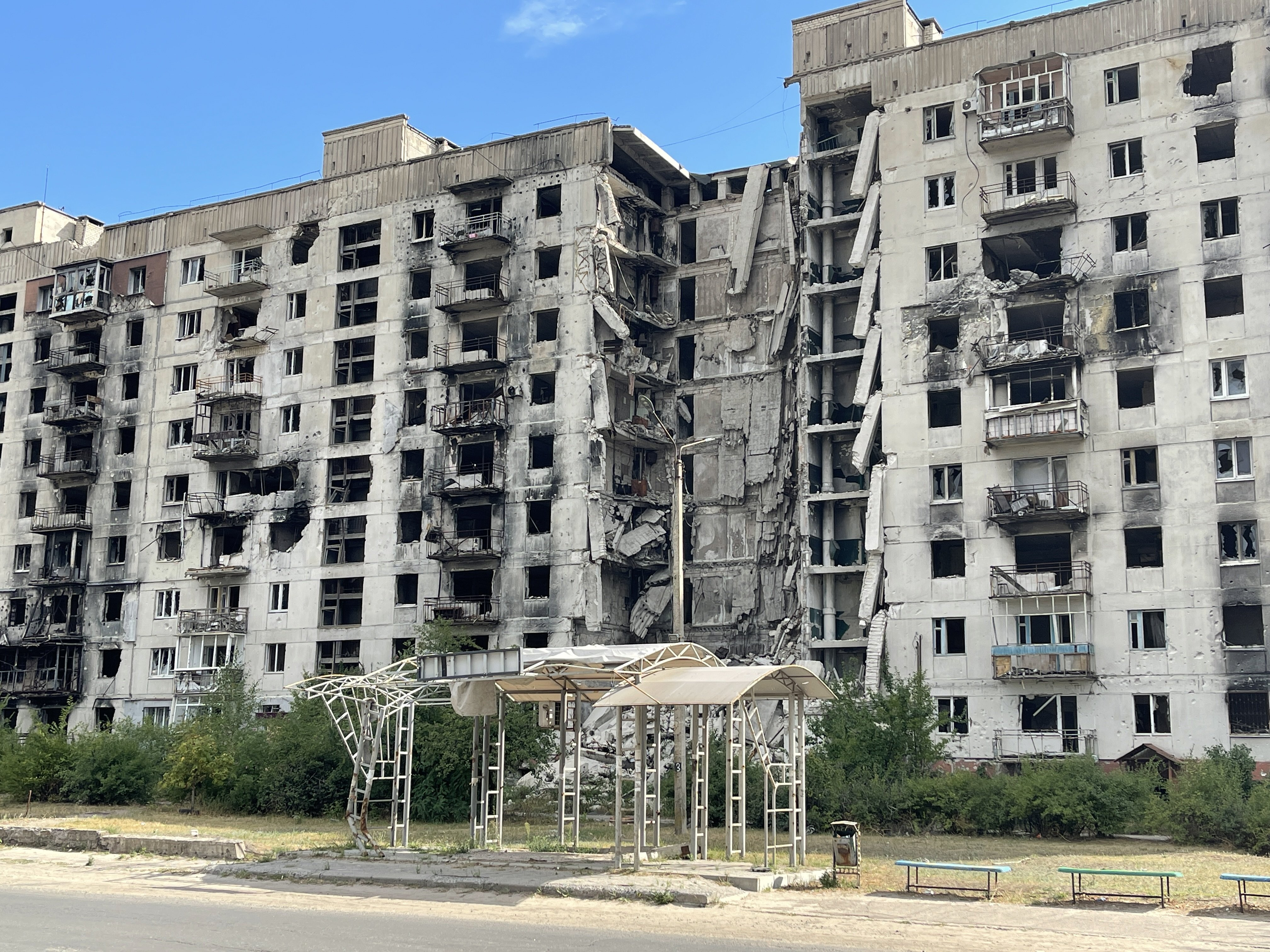
As I had an appointment in Copenhagen, we had to turn north, but at this point Zelensky had just launched his assault on Kursk, so we had to take the Kursk route. The assault earned Zelensky some media coverage and a pat on the shoulders from Lindsey Graham, one of the biggest political charlatans in American politics, and that says a lot. He openly admits that this war is a win-win situation for the US. Russia is weakened – he believes – but it is the Ukrainians who are dying and the American arms industry that is benefitting. He is an idiot when it comes to international politics and the military, but you have to give him credit for at least being honest. Zelensky pulled his best-trained troops away from the front in eastern Ukraine and sent them on an excursion to Kursk – bringing the best equipment he could find. And for what purpose? So that the Russians would feel the war, too? They already do along the border and gradually elsewhere as the drones reach them. But what Zelensky is really saying is that he wants to fight against civilian targets in Russia. That’s what he wants to do with long-range missiles. It’s a war crime, but everyone in the West is applauding and thus making themselves complicit. The Kursk Oblast is a rural area with no military fortifications because it has little significance and was therefore an unlikely target for aggression. That is, if it is not true that it was a trap set by the Russians themselves – which Zelensky fell into. I doubt that the Russians would set such a trap, but in any case, Zelensky’s entire expeditionary corps and all its equipment will be eliminated while the front in Donbas collapses for the Ukrainians. Most of all, this reminds me of the German Ardennes offensive at the end of World War II, but at least that had a well-defined – but also unrealistic – goal. Zelensky’s incursion into Kursk had no defined goal – unless it was to occupy the nuclear power plant in Kurchatov and trigger a nuclear disaster like Chernobyl. But then again, his handlers in the West would probably have applauded that, too.
The roads towards Kursk were heavily congested with military vehicles – including long columns of transports with tanks and other armored vehicles. Again, we had to take the side roads, as the main road was considered dangerous. It would be tempting for the Ukrainians to fire on these transports. There was a shortage of hotel rooms in Kursk city, but we managed to find one. There were air raid sirens both day and night and you quickly learned to listen for the location – was it close by or in another part of the city. If it was close, the sensible thing to do would have been to go down to the lobby or seek shelter, but there’s no need to overdramatize the situation. As my father said: “There is more space next to you!” From the window, you could follow the anti-aircraft rockets firing at drones and missiles. When a shot hits one of these flying objects, it explodes and falls from the sky in a cloud of sparks. It will hit somewhere, but as I said, there is more space next to you.
With a single stop in Tula, once known as Russia’s armory and gingerbread bakery, we made it back to Moscow unscathed.
In Russia, the war goes on and every day civilians are killed with Western weapons, guided by Western experts. Today, an ammunition depot in Tver oblast was blown up by a missile that some Russian experts say was fired from a NATO base in Latvia. If this turns out to be true, the war may well spread, and Latvia’s days will be numbered. Officials downplay the attack and say it was a drone: if so, it must have been a very large drone, indeed….
One can only wonder what this conflict has to do with us in the first place, but ignorance and a complete uniformity of the media means that we are lulled into absurd notions about Russia, and these absurd notions form the basis for far-reaching political decisions made by small-minded nobodies. A good example among many is Zelensky’s desire for Russians to feel the war in their everyday lives because they will then turn against Putin. However, historical experience says the exact opposite. Russians have lived through times so hard and chaotic that the clown in Kiev cannot imagine it. The more you push the Russians, the more they rally around their leadership. Russian history says so, but so does German history – and British history. Neither the bombing of German cities during World War II nor the Blitz in London had any real impact on the course of the war or people’s attitude towards their governments – on the contrary, they just came to hate the enemy even more. And the Ukrainians themselves live with great deprivation today, and Zelensky still claims that they support the war. Whether they do, of course, we do not know. I doubt it. Zelensky has not been elected because he does not dare to hold an election. The pied piper probably fears that he would be kicked out of the presidential residence in an election, and that his government and parliament would be following him. He was elected on a peace platform. He promised to make peace with Russia – but he allowed himself to be bought into a war that will destroy Ukraine. For Russia, this is an existential war – and Western statements about wanting to inflict defeat on the country and divide it into a myriad of small, insignificant statelets only reinforce this, but from Ukraine’s perspective it is a superfluous war. It is essentially a fratricidal war for American influence in Europe. Both the Minsk and Istanbul agreements would have secured Ukraine’s existence – and the rights of minorities. However, Ukrainians voted with their feet even then. They left the country, so that today the population has been halved.
It’s not Russia that wants to rule the world – it’s the US. Biden himself says that the US is “exceptional”, the most powerful country in the world. According to Biden, the US should lead the world, indeed, rule the world. And he links this insane view with democracy and freedom. Does the US really have democracy in the sense that the people have a say in how the nation is run? People in the West are upset that in Russia there is a commission that evaluates applications to run for president. An applicant must have something to offer! That’s not a criterion in the US, as we can clearly see. But it’s also not the case in the US that just anyone can run and hope to be elected. There are really only two electoral associations that want more or less the same thing politically. Today, they are therefore often referred to as “the uniparty”. Whether you can get elected is really determined by money. Can you raise enough money from donors? This is not called a democracy, but a plutocracy, because the people, companies and lobbyists who give politicians money naturally want something in return. It’s just Ukrainian corruption on a higher level. And honestly, can’t this exceptional so-called nation find better candidates to run for president than Trump and Harris? They’re basically two idiots – even though I have a lot of sympathy for Trump and think Harris belongs in an asylum. Could America not nominate better people with better qualifications? I could name quite a few without hesitation! The fact is, however, that it is not the President who runs America – it is the deep state, the administration, the media, Hollywood, Facebook and the lobbies, the most significant of which is the Jewish lobby! Until this system is effectively shut down, there can be no democracy. And furthermore: If the US is to lead the world, surely the world must also have the right to vote in US elections? Or? Hitler is accused of having wanted to rule the world, which is why it was necessary to stop him – just as it is supposedly necessary to stop Putin today. But neither of the two gentlemen wanted or wants to rule the world. Putin only wants to secure the rights of Russians wherever they live – and Hitler “only” wanted to subjugate Europe and enslave the eastern parts of it. Maybe it is now time to stop Biden and the forces that control him! They openly declare that they want to rule us all! And they are currently leading us into a nuclear war that will kill us. It is a limitation of the population surplus that really counts! Klaus Schwab, George Soros and Bill Gates send their regards.
Povl H. Riis-Knudsen
Translated by means of AI and slightly revised.
- Words mean something in Putin’s mouth. This is not a war – but a limited operation with a limited goal. A war is what Israel is waging in Gaza – and if the West interferes further in the limited military operation, it will automatically turn into a real war. ↩︎
- The preparations for it are captured on tape – there’s nothing to discuss about this question! ↩︎
 Danmarks Frihedsraad

